


原作者:ArchWiki 社区贡献者。本文依据 systemd/Journal 全文翻译整理;核对的固定版本为 oldid=881066,页面最后编辑于 2026-07-09 12:52。下载与全文核对日期为 2026-10-05。
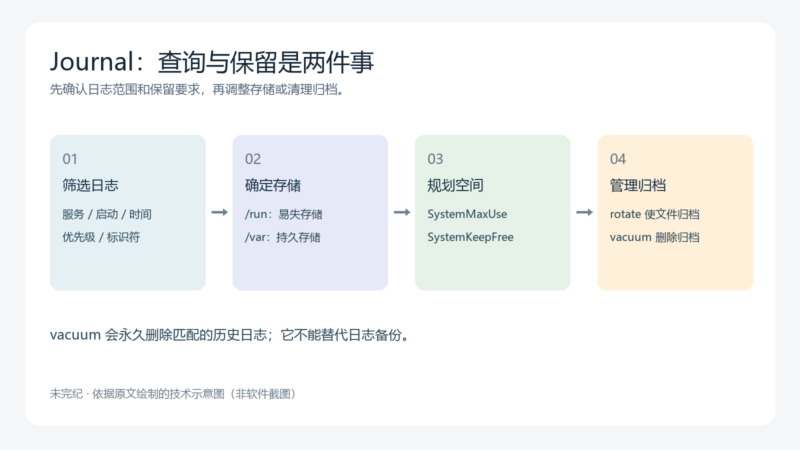
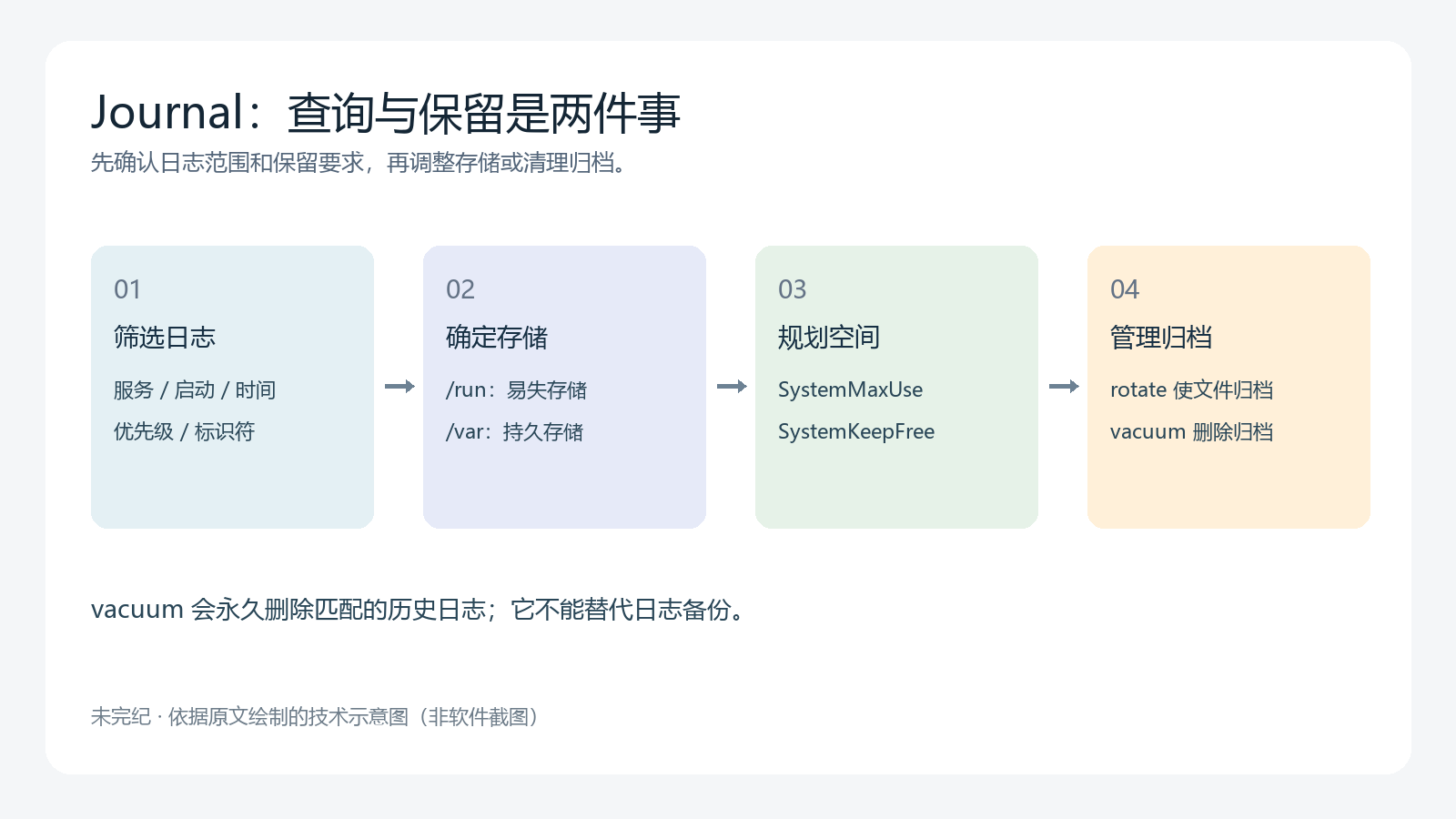
systemd 自带名为 journal 的日志系统,因此基本日志收集不要求再运行一个独立日志守护进程。它按优先级与 facility 对消息分类,这一分类沿用传统 Syslog 的概念。journalctl 用于读取日志;systemd-journald 则负责接收和保存它们。查询范围、读取权限、存储位置和历史保留是彼此相关但不同的问题。
一、查看已有日志,或追踪新日志
阅读 journal 通常有两种方式:翻看以前的记录,或持续观察新写入的消息。前一种方式常用 -e / --pager-end,直接把分页器定位到末尾;后一种方式用 -f / --follow。
journalctl -e
journalctl -f
原文提醒,这两个选项都会隐含某种 -n / --lines 限制,除非命令行已经另外指定。因此,想知道输出是否覆盖了全部历史,不能只看末尾显示了多少行。下面示例省略了原文表示 root 的 # 与普通用户的 $ 提示符;是否需要提权由日志文件的读取权限决定,并非所有查询都必须用 root。
二、先在 journalctl 中筛选
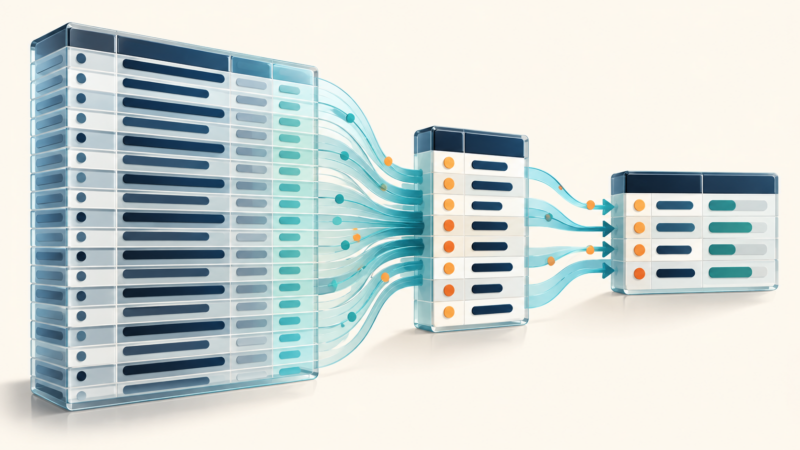
日志量大时,越早限定范围越容易阅读。journalctl 支持按日志字段筛选,例如 _PID=1,也可以按照可执行文件路径或内核设备选择记录。字段定义见 systemd.journal-fields(7),完整规则见 journalctl(1)。
| 目标 | 示例 | 含义或注意点 |
|---|---|---|
| 匹配消息 | journalctl --grep='PATTERN' |
PATTERN是要替换的表达式。原文建议优先于先输出全部再管道给grep,减少无用处理。 |
| 指定起点时间 | journalctl --since="2012-10-30 18:17:16" |
日期为原文示例,按实际故障时间替换。 |
| 最近一段时间 | journalctl --since "20 min ago" |
从20分钟前开始。 |
| 本次启动 | journalctl --boot |
把范围限制在当前启动轮次。 |
| 日志标识符 | journalctl --identifier sudo |
按标识符选择;不等同于按service单元名选择。 |
| 系统服务 | journalctl --unit man-db.service |
这里可省略.service后缀。 |
| 用户服务 | journalctl --user-unit dbus |
用户单元应使用–user-unit,避免与系统服务混淆。 |
| 指定优先级范围 | journalctl --priority err..alert |
包括3、2、1,即err、crit、alert;不包括0 emerg。 |
同一个优先级范围也可以写成 journalctl -p 3..1。若只给一个级别,例如 journalctl -p 3,则包括这个级别及所有更高优先级,即 0 到 3。数值越小越严重,不能把数字大小直接当成严重程度大小。
--catalog 会在有可用目录项时增加对消息的解释,journalctl --list-catalog 可以列出已知目录项。原文不建议在提交错误报告或支持帖的日志里默认启用它,因为附加解释容易挤占真正需要的上下文。
如果 /var/log/journal 包含大量日志,筛选也可能耗时。只关注当前系统日志时,原文给出的办法是把文件范围缩小到当前的 system.journal:
journalctl --file /var/log/journal/*/system.journal -f这会舍弃其他文件中的记录,尤其不应在需要完整历史的调查中随意使用。默认的广泛搜索范围变小了,所以速度变化不能被理解成“旧记录已经不存在”。
三、读取另一个系统的日志
故障系统无法正常启动时,可以在救援环境里把它的磁盘挂载到例如 /mnt,用 -D / --directory 指定日志目录:
journalctl -D /mnt/var/log/journal -e这条命令只说明如何选择已有日志,磁盘挂载本身不包含在命令中。编辑补充:为保留故障证据,优先考虑只读挂载和复制备份;不要在尚未确认数据范围时清理被救援系统的日志。
原文还介绍没有安装 systemd 时的应急办法。journal 虽是二进制格式,部分消息仍可被 strings 找到,再用关键词筛选:
strings /mnt/arch/var/log/journal/af4967d77fba44c6b093d0e9862f6ddd/system.journal | grep -i message路径里的机器标识和 message 都是原文示例,应替换成实际路径与搜索词。限制补充:这不是结构化 journal 解析器,不能保留字段关联、精确筛选语义,也不能保证找回压缩或损坏数据中的全部内容。找不到字符串不能证明事件没有发生。
四、优先级:严重程度的约定
Syslog 严重性代码在 systemd 中称为 priority。原文引用 RFC 5424 第 6.2.1 节,并给出下面的分级。表中示例为原文含义的中文整理:
| 值 | 名称 / 关键字 | 含义与例子 |
|---|---|---|
| 0 | Emergency / emerg | 系统已不可用,例如严重内核BUG或systemd自身崩溃。原文认为普通应用不应使用这一等级。 |
| 1 | Alert / alert | 需要立即处理,例如关键子系统停止工作、数据丢失或严重内核访存故障。 |
| 2 | Critical / crit | 严重状态,例如崩溃、core dump,或主要系统应用如X11失败。 |
| 3 | Error / err | 非致命错误,例如USB参数读取失败、卸载/var失败,或libvirt无法初始化防火墙后端。 |
| 4 | Warning / warning | 如果不采取行动可能出错,例如非根文件系统只剩少量空间,或程序回退到不匹配的locale。 |
| 5 | Notice / notice | 不寻常但不属于错误,例如在非空目录上继续挂载,或图形对话框缺少建议的父窗口关系。 |
| 6 | Informational / info | 正常操作消息,不要求处理,例如逻辑卷成功激活。 |
| 7 | Debug / debug | 为排错提供的细节,可能需要先启用,例如桌面电源管理器记录调度信息。 |
这些是建议,不是所有软件都严格遵守的标准。具体级别由应用开发者选择,同一个严重问题可能记录在比预想更高或更低的级别。因此只看 -p err 不能代替阅读故障上下文。
五、Facility:谁产生了这条日志
Facility 描述记录消息的程序类别,不表示严重程度。下面保留原文完整代码范围和名称;部分项目属于历史 Unix/Syslog 子系统:
| 代码 | 关键字或类别 | 说明 |
|---|---|---|
| 0 | kern | 内核消息 |
| 1 | user | 用户层消息 |
| 2 | 邮件系统,历史POSIX机制仍可能使用 | |
| 3 | daemon | 系统守护进程,包括systemd及其子系统 |
| 4 | auth | 安全与授权消息,同时也要注意代码10 |
| 5 | syslog | syslogd自身消息;原文将systemd自身归到3 |
| 6 | lpr | 行式打印子系统,历史类别 |
| 7 | news | 网络新闻子系统,历史类别 |
| 8 | uucp | UUCP子系统,历史类别 |
| 9 | Clock daemon | 时钟守护进程;原文举systemd-timesyncd |
| 10 | authpriv | 安全与授权消息,同时注意代码4 |
| 11 | ftp | FTP守护进程 |
| 12 | NTP subsystem | NTP子系统,原表未给关键字 |
| 13 | Log audit | 日志审计,原表未给关键字 |
| 14 | Log alert | 日志告警,原表未给关键字 |
| 15 | cron | 调度守护进程 |
| 16—23 | local0—local7 | 依次对应本地自定义用途0—7 |
原文建议留意 0、1、3、4、9、10、15 等 facility。它们是排查线索,仍应结合单元、标识符和时间判断来源,不能只靠类别推断实际权限或信任级别。
六、持久化、易失存储与 Storage=auto 的更正
在本次核对的 Arch Linux 文档中,/var/log/journal/ 由 systemd 软件包提供,默认使用 Storage=persistent。持久日志通常写在 /var/log/journal/;内存中的易失日志位于 /run/log/journal/,重新启动后不能指望保留。
对原文的技术更正:所核对的 Wiki 段落把手动配置 Storage=auto 描述成改写到 /run。根据同一发行版提供的 journald.conf(5),准确行为是:当 /var/log/journal 已存在时,auto 表现类似 persistent;目录不存在时,才类似 volatile。因此 auto 不是“始终仅写内存”的同义词。
同一手册还说明,即使使用 persistent,早期启动或磁盘不可写时也会退回 /run;启动过程中会由日志 flush 服务在条件具备后切换。默认值可以在编译时选择,别把 Arch Linux 的默认设置直接套用到所有发行版。
七、限制日志占用空间
原文给出的持久日志默认上限是所在文件系统大小的 10%,并有 4 GiB 的默认软上限。因此位于 20 GiB 文件系统时,示意上限约为 2 GiB;位于 50 GiB 文件系统时,按该默认规则最多约 4 GiB。实际值还受其他约束影响。
查看当前启动中 journald 的日志,有助于确认它报告的限制:
journalctl -b -u systemd-journald可以在 /etc/systemd/journald.conf 中设置 SystemMaxUse=50M,但原文也推荐使用 drop-in。下面使用本地覆盖常用的较高序号文件名;原文的名字是 00-journal-size.conf,此处改为 60-journal-size.conf,与当前手册对本地配置的排序建议一致。
文件:/etc/systemd/journald.conf.d/60-journal-size.conf
[Journal]
SystemMaxUse=50M
SystemMaxUse 表示日志最多使用多少空间,SystemKeepFree 表示为其他用途保留多少空间。原文注明后者默认按文件系统的 15% 计算;当前手册还说明两个比例计算出来的默认值各有 4G 上限。journald 同时遵守两类限制,实际可用量取更严格的约束。
修改后需要重新启动 systemd-journald.service 使新设置生效。这里不自动给出或执行服务变更;应先核对配置、保留要求与维护窗口。只针对持久存储的 System* 配置不能代替易失存储的 Runtime* 配置。
八、手工清理:只有归档文件参与 vacuum
原文提到可以直接从日志目录删除文件,也可以用 journalctl 按条件清理。本文不提供粗放删除目录的命令;需要管理历史时,优先理解归档、轮转和保留策略之间的关系。
下面两条会永久删除符合条件的历史日志,只用于理解原文。执行前必须完成所需备份,不应拿生产故障证据做练习。
# 删除归档日志,直到它们占用的空间降至100M以下
journalctl --vacuum-size=100M

# 按两周的时间条件删除归档日志
journalctl --vacuum-time=2weeks
vacuum 只处理已经轮转、处于非活动状态的 journal 文件。journalctl --rotate 可以先使当前文件归档;它也可以与 vacuum 条件放在同一命令中,按先轮转、后清理的顺序执行。本文没有运行任何一种清理。
只用 --vacuum-time 不应被理解成能逐条删除活动文件里的旧记录;只用 --vacuum-size 也不保证包含活动文件在内的总磁盘用量严格降到该数值以下。归档是按文件处理的,这一粒度影响清理结果。清理能减少历史存储,不能替代备份或长期归档。
九、用命名空间为某个服务单独配置日志
如果要为某个服务设置独立的日志保留上限,原文以 sshd 为例:在它的单元配置 [Service] 段增加 LogNamespace=ssh,再创建 /etc/systemd/journald@ssh.conf,按需要设置 SystemMaxUse。
# 服务单元的drop-in片段
[Service]
LogNamespace=ssh

# /etc/systemd/journald@ssh.conf中的相关片段
[Journal]
SystemMaxUse=50M与原文步骤的区别:原文建议复制整个 /etc/systemd/journald.conf 后修改;上面的示意仅列所需字段,避免误把所有旧配置冻结到新命名空间中。应用时应根据当前 systemd 的单元覆盖机制完成配置加载。重启该服务后,按原文说明会自动启动 systemd-journald@ssh.service;查看对应日志使用:
journalctl --namespace ssh命名空间不会让历史日志自动搬家。若选择 sshd 之类远程管理服务,重启与配置变更还可能影响管理连接,因此应在有恢复入口的维护环境中操作,而非在唯一远程会话里直接试错。详细机制见 systemd-journald.service(8) 的 Journal Namespaces。
十、与 Syslog 协作,或把消息送到控制台
与不了解 journal 的传统 Syslog 程序协作时,systemd 可以通过 /run/systemd/journal/syslog 转发消息;传统守护进程应绑定这个 socket,而不是 /dev/log。原文说 ForwardToSyslog=no 是避免额外开销的默认设置,因为 rsyslog 或 syslog-ng 可以自行从 journal 读取消息。应根据所选日志软件的输入方式配置,避免重复转发造成重复记录。
若想把日志转发到 /dev/tty12,原文给出的 drop-in 是:
文件:/etc/systemd/journald.conf.d/fw-tty12.conf
[Journal]
ForwardToConsole=yes
TTYPath=/dev/tty12
保存后需要重新启动 journald。原文说明,这个路径按设计不转发内核 ring buffer 消息。TTY 不一定非得是 12,但必须未被其他进程控制;使用 TTY 1—6 时还要核对 getty 等虚拟终端配置。编辑补充:控制台上的日志可能被本机旁观者看到,不能把这一转发当成没有数据暴露影响的显示设置。
十一、普通用户权限与几个阅读技巧
默认情况下,普通用户只能读取自己的 per-user journal。要允许读取系统日志,原文提到可将用户加入 systemd-journal 组;adm 和 wheel 组成员也被授予读取权限。实际权限仍受发行版和文件 ACL 配置影响。不要为了查看日志就把用户随意加入 wheel,该组在某些系统还有额外管理权限;日志中也可能含账号、路径或其他敏感数据。
原文还介绍 AUR 软件包 journalctl-desktop-notification,可把每个错误日志变成桌面通知。它是可选第三方工具,不是 journal 的必需组成部分。本文未安装或审查其代码;通知可能显示敏感消息,也可能在大量错误时造成干扰。
默认输出包含主机名,在同时看多台机器日志时很有用。只看单台机器、希望行更短时,可使用 -W / --no-hostname。如果截去主机名再分享,应另外保留足够的来源说明,避免混淆记录。
长行在分页器中默认可能被截断。SYSTEMD_LESS 控制传给 less 的选项,原文默认值为 FRSXMK;去掉 S 后,可以让长行折行显示:
SYSTEMD_LESS=FRXMK journalctl这是一条面向兼容 POSIX shell 的环境变量写法。若要长期启用,可在自己使用的 shell 环境配置中设置该变量,不要直接把语法套用到其他 shell。
只看内核消息时,可以把 journalctl 当作一种 dmesg 替代入口:
journalctl --dmesg历史(History)
原始文档:systemd/Journal,ArchWiki 社区贡献者编写、ArchWiki 发布;本文使用的2026年修订版本为 oldid=881066,公开源地址和贡献历史链接保留在文首及下节。中文修改版本:读懂 systemd Journal:日志筛选、离线排障、空间限制与命名空间,2026年,由未完纪以 Codex 辅助翻译整理;修改包括中文表达、技术更正、安全边界说明和原创配图。
归属、许可与本次改动
本文为 ArchWiki 社区文章的中文整理版本,原文与固定版本链接见文首;贡献记录见页面历史。ArchWiki 正文除另有说明外按 GNU Free Documentation License 1.3 或更高版本 提供,本次译文中属于原文派生的内容沿用该许可,完整许可文本见本文下方 GNU Free Documentation License 一节,由 SPDX 官方许可证目录取得;也可阅读 GFDL 1.3 完整文本。
中文改动与配图归属:未完纪,2026。允许按照自由软件基金会发布的 GNU Free Documentation License 1.3 或任何后续版本复制、分发和/或修改本文;本次版本没有不变章节、封面文字或封底文字。此声明不限制读者取得与编辑本文的 HTML 透明副本。
本次增加了 Storage=auto 更正、drop-in 排序与读取限制说明,明确标注清理、权限和服务重启影响;这些修改不应归为 ArchWiki 原作者的逐字表述。图为本次原创;没有对读者系统进行日志访问、命令执行或安全认证。
GNU Free Documentation License
GNU Free Documentation License
Version 1.3, 3 November 2008

Copyright (C) 2000, 2001, 2002, 2007, 2008 Free Software Foundation, Inc. <http://fsf.org/>

Everyone is permitted to copy and distribute verbatim copies of this license document, but changing it is not allowed.

0. PREAMBLE

The purpose of this License is to make a manual, textbook, or other functional and useful document "free" in the sense of freedom: to assure everyone the effective freedom to copy and redistribute it, with or without modifying it, either commercially or noncommercially. Secondarily, this License preserves for the author and publisher a way to get credit for their work, while not being considered responsible for modifications made by others.

This License is a kind of "copyleft", which means that derivative works of the document must themselves be free in the same sense. It complements the GNU General Public License, which is a copyleft license designed for free software.

We have designed this License in order to use it for manuals for free software, because free software needs free documentation: a free program should come with manuals providing the same freedoms that the software does. But this License is not limited to software manuals; it can be used for any textual work, regardless of subject matter or whether it is published as a printed book. We recommend this License principally for works whose purpose is instruction or reference.

1. APPLICABILITY AND DEFINITIONS

This License applies to any manual or other work, in any medium, that contains a notice placed by the copyright holder saying it can be distributed under the terms of this License. Such a notice grants a world-wide, royalty-free license, unlimited in duration, to use that work under the conditions stated herein. The "Document", below, refers to any such manual or work. Any member of the public is a licensee, and is addressed as "you". You accept the license if you copy, modify or distribute the work in a way requiring permission under copyright law.

A "Modified Version" of the Document means any work containing the Document or a portion of it, either copied verbatim, or with modifications and/or translated into another language.

A "Secondary Section" is a named appendix or a front-matter section of the Document that deals exclusively with the relationship of the publishers or authors of the Document to the Document's overall subject (or to related matters) and contains nothing that could fall directly within that overall subject. (Thus, if the Document is in part a textbook of mathematics, a Secondary Section may not explain any mathematics.) The relationship could be a matter of historical connection with the subject or with related matters, or of legal, commercial, philosophical, ethical or political position regarding them.

The "Invariant Sections" are certain Secondary Sections whose titles are designated, as being those of Invariant Sections, in the notice that says that the Document is released under this License. If a section does not fit the above definition of Secondary then it is not allowed to be designated as Invariant. The Document may contain zero Invariant Sections. If the Document does not identify any Invariant Sections then there are none.

The "Cover Texts" are certain short passages of text that are listed, as Front-Cover Texts or Back-Cover Texts, in the notice that says that the Document is released under this License. A Front-Cover Text may be at most 5 words, and a Back-Cover Text may be at most 25 words.

A "Transparent" copy of the Document means a machine-readable copy, represented in a format whose specification is available to the general public, that is suitable for revising the document straightforwardly with generic text editors or (for images composed of pixels) generic paint programs or (for drawings) some widely available drawing editor, and that is suitable for input to text formatters or for automatic translation to a variety of formats suitable for input to text formatters. A copy made in an otherwise Transparent file format whose markup, or absence of markup, has been arranged to thwart or discourage subsequent modification by readers is not Transparent. An image format is not Transparent if used for any substantial amount of text. A copy that is not "Transparent" is called "Opaque".

Examples of suitable formats for Transparent copies include plain ASCII without markup, Texinfo input format, LaTeX input format, SGML or XML using a publicly available DTD, and standard-conforming simple HTML, PostScript or PDF designed for human modification. Examples of transparent image formats include PNG, XCF and JPG. Opaque formats include proprietary formats that can be read and edited only by proprietary word processors, SGML or XML for which the DTD and/or processing tools are not generally available, and the machine-generated HTML, PostScript or PDF produced by some word processors for output purposes only.

The "Title Page" means, for a printed book, the title page itself, plus such following pages as are needed to hold, legibly, the material this License requires to appear in the title page. For works in formats which do not have any title page as such, "Title Page" means the text near the most prominent appearance of the work's title, preceding the beginning of the body of the text.

The "publisher" means any person or entity that distributes copies of the Document to the public.

A section "Entitled XYZ" means a named subunit of the Document whose title either is precisely XYZ or contains XYZ in parentheses following text that translates XYZ in another language. (Here XYZ stands for a specific section name mentioned below, such as "Acknowledgements", "Dedications", "Endorsements", or "History".) To "Preserve the Title" of such a section when you modify the Document means that it remains a section "Entitled XYZ" according to this definition.

The Document may include Warranty Disclaimers next to the notice which states that this License applies to the Document. These Warranty Disclaimers are considered to be included by reference in this License, but only as regards disclaiming warranties: any other implication that these Warranty Disclaimers may have is void and has no effect on the meaning of this License.

2. VERBATIM COPYING

You may copy and distribute the Document in any medium, either commercially or noncommercially, provided that this License, the copyright notices, and the license notice saying this License applies to the Document are reproduced in all copies, and that you add no other conditions whatsoever to those of this License. You may not use technical measures to obstruct or control the reading or further copying of the copies you make or distribute. However, you may accept compensation in exchange for copies. If you distribute a large enough number of copies you must also follow the conditions in section 3.

You may also lend copies, under the same conditions stated above, and you may publicly display copies.

3. COPYING IN QUANTITY

If you publish printed copies (or copies in media that commonly have printed covers) of the Document, numbering more than 100, and the Document's license notice requires Cover Texts, you must enclose the copies in covers that carry, clearly and legibly, all these Cover Texts: Front-Cover Texts on the front cover, and Back-Cover Texts on the back cover. Both covers must also clearly and legibly identify you as the publisher of these copies. The front cover must present the full title with all words of the title equally prominent and visible. You may add other material on the covers in addition. Copying with changes limited to the covers, as long as they preserve the title of the Document and satisfy these conditions, can be treated as verbatim copying in other respects.

If the required texts for either cover are too voluminous to fit legibly, you should put the first ones listed (as many as fit reasonably) on the actual cover, and continue the rest onto adjacent pages.

If you publish or distribute Opaque copies of the Document numbering more than 100, you must either include a machine-readable Transparent copy along with each Opaque copy, or state in or with each Opaque copy a computer-network location from which the general network-using public has access to download using public-standard network protocols a complete Transparent copy of the Document, free of added material. If you use the latter option, you must take reasonably prudent steps, when you begin distribution of Opaque copies in quantity, to ensure that this Transparent copy will remain thus accessible at the stated location until at least one year after the last time you distribute an Opaque copy (directly or through your agents or retailers) of that edition to the public.

It is requested, but not required, that you contact the authors of the Document well before redistributing any large number of copies, to give them a chance to provide you with an updated version of the Document.

4. MODIFICATIONS

You may copy and distribute a Modified Version of the Document under the conditions of sections 2 and 3 above, provided that you release the Modified Version under precisely this License, with the Modified Version filling the role of the Document, thus licensing distribution and modification of the Modified Version to whoever possesses a copy of it. In addition, you must do these things in the Modified Version:

     A. Use in the Title Page (and on the covers, if any) a title distinct from that of the Document, and from those of previous versions (which should, if there were any, be listed in the History section of the Document). You may use the same title as a previous version if the original publisher of that version gives permission.
     B. List on the Title Page, as authors, one or more persons or entities responsible for authorship of the modifications in the Modified Version, together with at least five of the principal authors of the Document (all of its principal authors, if it has fewer than five), unless they release you from this requirement.
     C. State on the Title page the name of the publisher of the Modified Version, as the publisher.
     D. Preserve all the copyright notices of the Document.
     E. Add an appropriate copyright notice for your modifications adjacent to the other copyright notices.
     F. Include, immediately after the copyright notices, a license notice giving the public permission to use the Modified Version under the terms of this License, in the form shown in the Addendum below.
     G. Preserve in that license notice the full lists of Invariant Sections and required Cover Texts given in the Document's license notice. H. Include an unaltered copy of this License.
     I. Preserve the section Entitled "History", Preserve its Title, and add to it an item stating at least the title, year, new authors, and publisher of the Modified Version as given on the Title Page. If there is no section Entitled "History" in the Document, create one stating the title, year, authors, and publisher of the Document as given on its Title Page, then add an item describing the Modified Version as stated in the previous sentence.
     J. Preserve the network location, if any, given in the Document for public access to a Transparent copy of the Document, and likewise the network locations given in the Document for previous versions it was based on. These may be placed in the "History" section. You may omit a network location for a work that was published at least four years before the Document itself, or if the original publisher of the version it refers to gives permission.
     K. For any section Entitled "Acknowledgements" or "Dedications", Preserve the Title of the section, and preserve in the section all the substance and tone of each of the contributor acknowledgements and/or dedications given therein.
     L. Preserve all the Invariant Sections of the Document, unaltered in their text and in their titles. Section numbers or the equivalent are not considered part of the section titles.
     M. Delete any section Entitled "Endorsements". Such a section may not be included in the Modified Version.
     N. Do not retitle any existing section to be Entitled "Endorsements" or to conflict in title with any Invariant Section.
     O. Preserve any Warranty Disclaimers.

If the Modified Version includes new front-matter sections or appendices that qualify as Secondary Sections and contain no material copied from the Document, you may at your option designate some or all of these sections as invariant. To do this, add their titles to the list of Invariant Sections in the Modified Version's license notice. These titles must be distinct from any other section titles.

You may add a section Entitled "Endorsements", provided it contains nothing but endorsements of your Modified Version by various parties--for example, statements of peer review or that the text has been approved by an organization as the authoritative definition of a standard.

You may add a passage of up to five words as a Front-Cover Text, and a passage of up to 25 words as a Back-Cover Text, to the end of the list of Cover Texts in the Modified Version. Only one passage of Front-Cover Text and one of Back-Cover Text may be added by (or through arrangements made by) any one entity. If the Document already includes a cover text for the same cover, previously added by you or by arrangement made by the same entity you are acting on behalf of, you may not add another; but you may replace the old one, on explicit permission from the previous publisher that added the old one.

The author(s) and publisher(s) of the Document do not by this License give permission to use their names for publicity for or to assert or imply endorsement of any Modified Version.

5. COMBINING DOCUMENTS

You may combine the Document with other documents released under this License, under the terms defined in section 4 above for modified versions, provided that you include in the combination all of the Invariant Sections of all of the original documents, unmodified, and list them all as Invariant Sections of your combined work in its license notice, and that you preserve all their Warranty Disclaimers.

The combined work need only contain one copy of this License, and multiple identical Invariant Sections may be replaced with a single copy. If there are multiple Invariant Sections with the same name but different contents, make the title of each such section unique by adding at the end of it, in parentheses, the name of the original author or publisher of that section if known, or else a unique number. Make the same adjustment to the section titles in the list of Invariant Sections in the license notice of the combined work.

In the combination, you must combine any sections Entitled "History" in the various original documents, forming one section Entitled "History"; likewise combine any sections Entitled "Acknowledgements", and any sections Entitled "Dedications". You must delete all sections Entitled "Endorsements".

6. COLLECTIONS OF DOCUMENTS

You may make a collection consisting of the Document and other documents released under this License, and replace the individual copies of this License in the various documents with a single copy that is included in the collection, provided that you follow the rules of this License for verbatim copying of each of the documents in all other respects.

You may extract a single document from such a collection, and distribute it individually under this License, provided you insert a copy of this License into the extracted document, and follow this License in all other respects regarding verbatim copying of that document.

7. AGGREGATION WITH INDEPENDENT WORKS

A compilation of the Document or its derivatives with other separate and independent documents or works, in or on a volume of a storage or distribution medium, is called an "aggregate" if the copyright resulting from the compilation is not used to limit the legal rights of the compilation's users beyond what the individual works permit. When the Document is included in an aggregate, this License does not apply to the other works in the aggregate which are not themselves derivative works of the Document.

If the Cover Text requirement of section 3 is applicable to these copies of the Document, then if the Document is less than one half of the entire aggregate, the Document's Cover Texts may be placed on covers that bracket the Document within the aggregate, or the electronic equivalent of covers if the Document is in electronic form. Otherwise they must appear on printed covers that bracket the whole aggregate.

8. TRANSLATION

Translation is considered a kind of modification, so you may distribute translations of the Document under the terms of section 4. Replacing Invariant Sections with translations requires special permission from their copyright holders, but you may include translations of some or all Invariant Sections in addition to the original versions of these Invariant Sections. You may include a translation of this License, and all the license notices in the Document, and any Warranty Disclaimers, provided that you also include the original English version of this License and the original versions of those notices and disclaimers. In case of a disagreement between the translation and the original version of this License or a notice or disclaimer, the original version will prevail.

If a section in the Document is Entitled "Acknowledgements", "Dedications", or "History", the requirement (section 4) to Preserve its Title (section 1) will typically require changing the actual title.

9. TERMINATION

You may not copy, modify, sublicense, or distribute the Document except as expressly provided under this License. Any attempt otherwise to copy, modify, sublicense, or distribute it is void, and will automatically terminate your rights under this License.

However, if you cease all violation of this License, then your license from a particular copyright holder is reinstated (a) provisionally, unless and until the copyright holder explicitly and finally terminates your license, and (b) permanently, if the copyright holder fails to notify you of the violation by some reasonable means prior to 60 days after the cessation.

Moreover, your license from a particular copyright holder is reinstated permanently if the copyright holder notifies you of the violation by some reasonable means, this is the first time you have received notice of violation of this License (for any work) from that copyright holder, and you cure the violation prior to 30 days after your receipt of the notice.

Termination of your rights under this section does not terminate the licenses of parties who have received copies or rights from you under this License. If your rights have been terminated and not permanently reinstated, receipt of a copy of some or all of the same material does not give you any rights to use it.

10. FUTURE REVISIONS OF THIS LICENSE

The Free Software Foundation may publish new, revised versions of the GNU Free Documentation License from time to time. Such new versions will be similar in spirit to the present version, but may differ in detail to address new problems or concerns. See http://www.gnu.org/copyleft/.

Each version of the License is given a distinguishing version number. If the Document specifies that a particular numbered version of this License "or any later version" applies to it, you have the option of following the terms and conditions either of that specified version or of any later version that has been published (not as a draft) by the Free Software Foundation. If the Document does not specify a version number of this License, you may choose any version ever published (not as a draft) by the Free Software Foundation. If the Document specifies that a proxy can decide which future versions of this License can be used, that proxy's public statement of acceptance of a version permanently authorizes you to choose that version for the Document.

11. RELICENSING

"Massive Multiauthor Collaboration Site" (or "MMC Site") means any World Wide Web server that publishes copyrightable works and also provides prominent facilities for anybody to edit those works. A public wiki that anybody can edit is an example of such a server. A "Massive Multiauthor Collaboration" (or "MMC") contained in the site means any set of copyrightable works thus published on the MMC site.

"CC-BY-SA" means the Creative Commons Attribution-Share Alike 3.0 license published by Creative Commons Corporation, a not-for-profit corporation with a principal place of business in San Francisco, California, as well as future copyleft versions of that license published by that same organization.

"Incorporate" means to publish or republish a Document, in whole or in part, as part of another Document.

An MMC is "eligible for relicensing" if it is licensed under this License, and if all works that were first published under this License somewhere other than this MMC, and subsequently incorporated in whole or in part into the MMC, (1) had no cover texts or invariant sections, and (2) were thus incorporated prior to November 1, 2008.

The operator of an MMC Site may republish an MMC contained in the site under CC-BY-SA on the same site at any time before August 1, 2009, provided the MMC is eligible for relicensing.

ADDENDUM: How to use this License for your documents

To use this License in a document you have written, include a copy of the License in the document and put the following copyright and license notices just after the title page:

 Copyright (c) YEAR YOUR NAME. Permission is granted to copy, distribute and/or modify this document under the terms of the GNU Free Documentation License, Version 1.3 or any later version published by the Free Software Foundation; with no Invariant Sections, no Front-Cover Texts, and no Back-Cover Texts. A copy of the license is included in the section entitled "GNU Free Documentation License".

If you have Invariant Sections, Front-Cover Texts and Back-Cover Texts, replace the "with...Texts." line with this:

 with the Invariant Sections being LIST THEIR TITLES, with the Front-Cover Texts being LIST, and with the Back-Cover Texts being LIST.

If you have Invariant Sections without Cover Texts, or some other combination of the three, merge those two alternatives to suit the situation.

If your document contains nontrivial examples of program code, we recommend releasing these examples in parallel under your choice of free software license, such as the GNU General Public License, to permit their use in free software.






暂无评论内容