


用 Qt 实现带保存保护的手绘画板
原文标题:Scribble Example | Qt Widgets | Qt 6.12.0。原页面标注 The Qt Company Ltd. 及文档贡献者的版权;未列个人作者名单。中文改编作者:未完纪;改编出版方:未完纪。
原文版权:© 2026 The Qt Company Ltd.;文档贡献分别归各贡献者所有。本文改编部分版权:© 2026 未完纪。
原文页面标注 GNU Free Documentation License 1.3;完整原许可文本保留于下方章节。本文中文翻译与改编依据另行取得的许可制作;保留原作者、版权与来源,不将原文许可误写为中文改编的唯一授权依据。
一个能画线的窗口,离可用的画板还差几件事:被其他窗口遮挡后要能恢复画面,调整窗口时不能丢掉笔迹,打开新图片或退出时要处理尚未保存的内容。Qt 官方 Scribble 示例把这些问题放在同一个小程序里,适合用来理解 QWidget 事件、QImage 画布和文件生命周期如何协作。
本文依据 Qt 官方 Scribble Example 编译,页面标示 Qt 6.12.0。原作者为 The Qt Company 与文档贡献者。下文完整解释原页工作流程,合并重复的声明与菜单样板代码;核心代码沿用原例,编者建议单独标明。完整项目以页面末尾的官方源码链接为准。本文只做静态审查,未构建或运行程序。
把绘图区和主窗口分成两个类
ScribbleArea 继承 QWidget,保存图像并处理绘图事件;MainWindow 继承 QMainWindow,管理菜单、打开保存和关闭确认。File 菜单包含打开图片、按格式另存、打印和退出;Options 菜单负责画笔颜色、宽度和清空;Help 菜单显示示例说明与 Qt 信息。
绘图区需要这些状态:
bool modified = false;
bool scribbling = false;
int myPenWidth = 1;
QColor myPenColor = Qt::blue;
QImage image;
QPoint lastPoint;
modified 表示当前图像有未保存修改;scribbling 表示这一轮左键绘制由本控件发起;画笔宽度和颜色用于后续笔画;image 保存像素;lastPoint 保存上一次按下或移动事件的坐标。绘图区对外提供 openImage()、saveImage()、画笔设置与读取方法,以及 clearImage()、print() 槽。它重写鼠标按下、移动、释放、绘制和尺寸变化五类事件。
构造函数给绘图区设置 Qt::WA_StaticContents。它向 Qt 表示内容固定在左上角,窗口调整尺寸时原有内容不会重新布局,便于优化重绘。这个属性只适合符合该前提的控件,不应当当作所有绘图控件的通用开关。
鼠标事件负责记录轨迹,QImage 负责留下笔迹
void ScribbleArea::mousePressEvent(QMouseEvent *event)
{
    if (event->button() == Qt::LeftButton) {
        lastPoint = event->position().toPoint();
        scribbling = true;
    }
}

void ScribbleArea::mouseMoveEvent(QMouseEvent *event)
{
    if ((event->buttons() & Qt::LeftButton) && scribbling)
        drawLineTo(event->position().toPoint());
}

void ScribbleArea::mouseReleaseEvent(QMouseEvent *event)
{
    if (event->button() == Qt::LeftButton && scribbling) {
        drawLineTo(event->position().toPoint());
        scribbling = false;
    }
}
按下和释放事件使用 button() 判断引发事件的是哪一个按键;移动事件使用 buttons() 检查当前仍然按住的所有按键。二者不能混用。scribbling 也不能省略:控件收到一次移动或释放事件,并不保证之前的按下事件一定发生在同一个控件上。
每次移动都把上一个采样点与当前点连起来,而不是只在当前位置画一个点;释放时再补最后一段,结束这一轮绘制。Qt 6 的 position() 返回浮点坐标,示例通过 toPoint() 转成整数像素位置,属于这个像素画板的设计选择。
void ScribbleArea::drawLineTo(const QPoint &endPoint)
{
    QPainter painter(&image);
    painter.setPen(QPen(myPenColor, myPenWidth, Qt::SolidLine,
                        Qt::RoundCap, Qt::RoundJoin));
    painter.drawLine(lastPoint, endPoint);
    modified = true;

    int rad = (myPenWidth / 2) + 2;
    update(QRect(lastPoint, endPoint).normalized()
               .adjusted(-rad, -rad, +rad, +rad));
    lastPoint = endPoint;
}
这里的 QPainter 以 image 为绘制设备。线帽和连接处使用圆形,连续线段的接缝更自然。绘制后立即标记未保存,提交需要刷新的矩形,最后把当前终点变成下一段的起点。
QRect(lastPoint, endPoint) 可能因拖动方向不同而得到反向矩形,因此先用 normalized() 规范化,再按半个线宽外加余量扩张边界,避免粗线边缘漏刷。update() 是请求后续重绘,不等于立即、同步执行一次 paintEvent();Qt 可以合并刷新请求。
paintEvent 只负责把画布显示出来
void ScribbleArea::paintEvent(QPaintEvent *event)
{
    QPainter painter(this);
    QRect dirtyRect = event->rect();
    painter.drawImage(dirtyRect, image, dirtyRect);
}
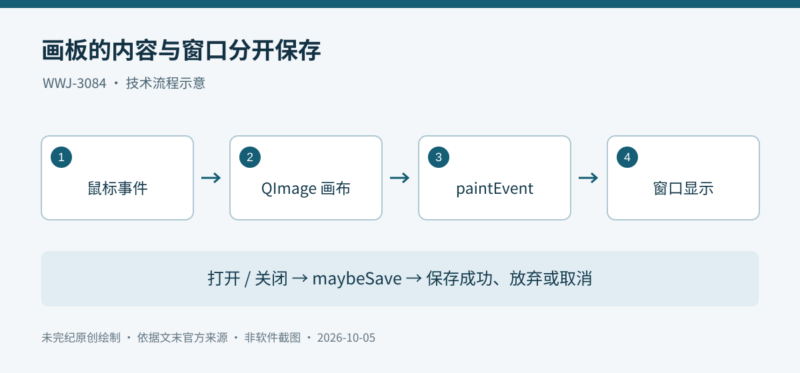
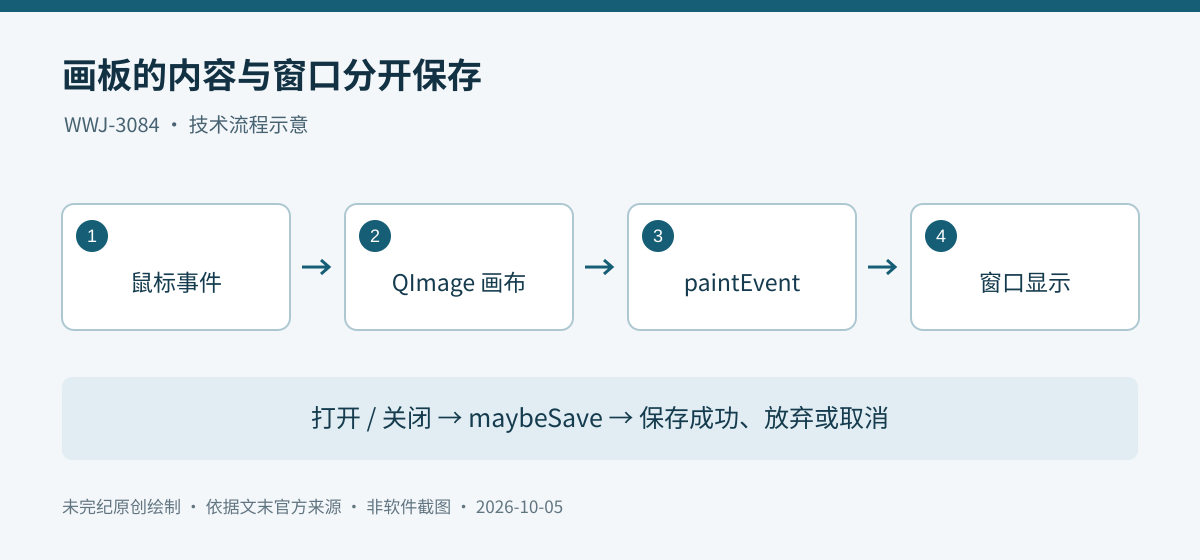
绘制事件创建面向控件的 QPainter,把需要刷新的图像区域复制到窗口对应位置。鼠标事件向 QImage 绘图、绘制事件向窗口绘图,两者分工明确。
为什么不在鼠标回调里直接往窗口上画?第一,窗口系统可以在遮挡、最小化或恢复之后要求重绘,不能指望屏幕替程序永久记住笔迹。第二,Qt 通常要求对 QWidget 的绘制在 paintEvent() 内进行;原文提及的 WA_PaintOnScreen 是特殊路径,不是本例需要使用的方案。第三,正确初始化的 QImage 能保存确定的颜色通道数据;先画到显示设备再回读,可能受显示设备色深影响而丢失信息。
扩大的是画布,不是把旧图拉伸
首次显示窗口时,尺寸变化事件会创建初始画布。之后只有控件宽或高超过当前图像时才扩容。示例每次多留 128 像素,减少连续拖动窗口边缘时反复分配图像的次数:
void ScribbleArea::resizeEvent(QResizeEvent *event)
{
    if (width() > image.width() || height() > image.height()) {
        int newWidth = qMax(width() + 128, image.width());
        int newHeight = qMax(height() + 128, image.height());
        resizeImage(&image, QSize(newWidth, newHeight));
        update();
    }
    QWidget::resizeEvent(event);
}

void ScribbleArea::resizeImage(QImage *image, const QSize &newSize)
{
    if (image->size() == newSize)
        return;

    QImage newImage(newSize, QImage::Format_RGB32);
    newImage.fill(qRgb(255, 255, 255));
    QPainter painter(&newImage);
    painter.drawImage(QPoint(0, 0), *image);
    *image = newImage;
}
resizeImage() 创建指定尺寸的新图,用白色填充,再把旧图绘到左上角。因此原笔迹的位置和大小不变,新增区域是白色;它不是图像缩放操作。原文没有直接用 QImage::copy() 扩大图像,因为扩出的区域会是黑色,和白色画布要求不符。
Format_RGB32 的像素按 0xffRRGGBB 保存,最高字节固定为不透明。编者说明:这也意味着示例不是保留透明图层的编辑器;载入有透明度的图片后,经这条白底复制路径形成的是不透明画布。
打开、保存和清空都要更新修改状态
bool ScribbleArea::openImage(const QString &fileName)
{
    QImage loadedImage;
    if (!loadedImage.load(fileName))
        return false;

    QSize newSize = loadedImage.size().expandedTo(size());
    resizeImage(&loadedImage, newSize);
    image = loadedImage;
    modified = false;
    update();
    return true;
}

bool ScribbleArea::saveImage(const QString &fileName,
                             const char *fileFormat)
{
    QImage visibleImage = image;
    resizeImage(&visibleImage, size());

    if (visibleImage.save(fileName, fileFormat)) {
        modified = false;
        return true;
    }
    return false;
}

void ScribbleArea::clearImage()
{
    image.fill(qRgb(255, 255, 255));
    modified = true;
    update();
}
打开操作先把文件载入临时图像;载入失败就返回,不替换现有图像。成功后,用 expandedTo(size()) 让画布在两个方向上至少覆盖控件,然后重置修改标记并刷新显示。
这里有一个必须理解的保存语义:saveImage() 复制画布后,把副本调整到当前控件尺寸再写盘,所以保存的只是可见区域。窗口缩小后,内存里可能仍保留更大的画布,而保存文件会裁掉窗口之外的像素。成功写盘才清除 modified;失败时仍保持未保存状态。
清空操作把整张内存画布涂白,并标记修改。它没有自动保存,也没有撤销功能;原例把菜单直接连接到 clearImage(),不会先弹出保存确认。标题中的保存保护主要覆盖打开新文件与关闭窗口,不能理解为所有破坏性动作都有保护。
画笔颜色和宽度的 setter 只改变将来的笔画,并不重画已有笔迹。主窗口通过 QColorDialog 选色,只有 isValid() 为真才接受;用 QInputDialog::getInt() 选择宽度,范围是 1 到 50,步长为 1,只有用户确认后才应用。
主窗口如何安排动作与菜单
MainWindow 的构造函数创建 ScribbleArea,调用 setCentralWidget() 把它作为中央控件,再依次建立动作和菜单,窗口标题设为 Scribble,初始尺寸为 500×500。子对象带有父对象,生命周期由 Qt 对象关系管理。
createActions() 创建 Open、Print、Exit、Pen Color、Pen Width、Clear Screen、About、About Qt 等 QAction,并把 triggered 信号连接到对应槽。Open 使用标准打开快捷键,Exit 使用标准退出快捷键,清空在原例中绑定为 Ctrl+L。About 显示本示例覆盖哪些事件与绘图能力,About Qt 调用 QApplication 的对应信息窗口。
另存菜单根据 QImageWriter::supportedImageFormats() 枚举运行环境可写的图片格式。每个格式对应一个 QAction:菜单显示大写格式名,真正的格式标识通过 setData(format) 保存在动作里,保存时用 data() 取回,而不是从翻译后的菜单文字反推。
createMenus() 把格式动作加入 Save As 子菜单,再把各动作安排到 File、Options、Help,最后通过 menuBar() 加到窗口。实际支持哪些格式取决于 Qt 构建与已部署的图像插件,不应把开发机上的格式清单当作部署环境保证。
原例的 save() 从 sender() 取得发出信号的 QAction,用 qobject_cast<QAction *> 转换后取出格式,并调用 saveFile()。原文强调了类型检查,但转换失败仍会返回空指针,而原代码没有判空就解引用。编者加固建议:若此槽以后可能被别的对象调用,应在读取 action->data() 前检查 action,或改成连接 lambda 直接捕获格式。正常的原菜单连接路径符合其假设,但这不构成任意调用下的安全保证。
保存确认的返回值决定能否继续
关闭事件不直接退出,而是先询问 maybeSave():
void MainWindow::closeEvent(QCloseEvent *event)
{
    if (maybeSave())
        event->accept();
    else
        event->ignore();
}

bool MainWindow::maybeSave()
{
    if (scribbleArea->isModified()) {
        QMessageBox::StandardButton ret;
        ret = QMessageBox::warning(this, tr("Scribble"),
                tr("The image has been modified.\n"
                   "Do you want to save your changes?"),
                QMessageBox::Save | QMessageBox::Discard
                | QMessageBox::Cancel);
        if (ret == QMessageBox::Save)
            return saveFile("png");
        else if (ret == QMessageBox::Cancel)
            return false;
    }
    return true;
}
没有修改就允许继续。存在修改时,Save 尝试以 PNG 保存;Discard 明确允许放弃;Cancel 阻止后续动作。选择 Save 后,返回的仍然是 saveFile() 的结果,所以用户取消文件对话框,或底层保存失败,也会阻止关闭。原页部分文字把返回 false 简写为“用户点击 Cancel”,这里按照实际代码补全了失败路径。
open() 使用同一个门禁:只有 maybeSave() 返回 true 才打开文件选择对话框;文件名非空才调用 openImage()。因此从 File → Exit 退出和点击窗口关闭按钮都能通过关闭事件获得保护,打开另一个文件也不会跳过当前修改的处理。
saveFile() 建议一个位于当前目录、名为 untitled.格式 的路径,通过 QFileDialog::getSaveFileName() 让用户确定保存位置;返回空文件名时返回 false,否则把文件名和格式交给绘图区。选择文件名不代表保存已经完成,只有图像写入函数的结果才能决定状态。
编者加固建议:原 open() 没有使用 openImage() 的失败返回值,用户可能不知道文件未能载入;保存失败也缺少具体错误说明。实际产品应反馈失败原因。若增加“清空前确认”,可在连接清空动作时调用 maybeSave(),确认通过后再执行 clearImage()。这些属于行为改动,并非原例已有功能。
打印是一种不同的绘制设备
打印槽在 QT_PRINTSUPPORT_LIB 和 QT_CONFIG(printdialog) 条件允许时启用。它创建高分辨率 QPrinter 和 QPrintDialog;用户接受打印对话框后,再创建以打印机为设备的 QPainter。
QPainter painter(&printer);
QRect rect = painter.viewport();
QSize size = image.size();
size.scale(rect.size(), Qt::KeepAspectRatio);
painter.setViewport(rect.x(), rect.y(), size.width(), size.height());
painter.setWindow(image.rect());
painter.drawImage(0, 0, image);
代码把图像按比例缩放到打印视口可用空间内,再通过视口与逻辑窗口的映射绘制。注意它使用的是整张 image,与另存时只保存可见区域的实现并不相同。是否能打开打印对话框、使用哪个打印后端,都需要在目标系统与 Qt 构建中验证。
从教学示例走向实际工具还需要哪些取舍
第一,明确文档尺寸与窗口尺寸是否应该绑定。如果要保存整张画布,可以把保存逻辑改为直接保存 image,但这样会把预分配的 128 像素白边也纳入文件。更完整的实现应独立记录文档尺寸,把视口大小和缓存容量分开。不能只删掉一行裁剪代码就声称问题完全解决。
第二,为加载图片和扩容设定合理的尺寸与资源上限,并检查创建新 QImage 是否失败。原例没有显式处理大图占用内存、分配失败或复杂图像解码的边界,也没有事务式文件保存、自动备份和撤销历史。读取不可信图片及覆盖已有文件,需要在真实产品中单独设计。
第三,验证这些实际路径:画线后最小化并恢复;扩大和缩小窗口;保存后重新打开;在 Save、Discard、Cancel 三种选择下关闭和打开;模拟无法写入的路径;尝试清空;验证部署包里的图像格式与打印功能。这是建议的验证清单,不是本次已完成的测试记录。
原文页面 © 2026 The Qt Company Ltd.,文档贡献归各贡献者所有,文档采用 GNU Free Documentation License 1.3。已核对示例的 scribblearea.cpp 与 mainwindow.cpp:源文件 Copyright (C) 2016 The Qt Company Ltd.,SPDX 标记为 LicenseRef-Qt-Commercial OR BSD-3-Clause。本文使用 BSD-3-Clause 选项;代码片段经翻译与重排,并附编者说明,非原始源文件。Qt 及相关标识属于相应商标权利人。本文未使用软件截图或 Logo,流程图为原创。下附文档与代码适用许可全文;许可证全文见文末。
History
- 2026:原文 Scribble Example | Qt Widgets | Qt 6.12.0,Qt 官方文档页面;来源为 Qt Scribble Example,版权标注 © 2026 The Qt Company Ltd. 及各文档贡献者。
- 2026:中文版《用 Qt 实现带保存保护的手绘画板》,改编作者未完纪,出版方未完纪;翻译并重排原文说明与代码片段,加入标注的技术和安全边界说明及原创示意图。
GNU Free Documentation License
Copyright (c) 2026 未完纪. Permission is granted to copy, distribute and/or modify this document under the terms of the GNU Free Documentation License, Version 1.3; with no Invariant Sections, no Front-Cover Texts, and no Back-Cover Texts. A copy of the license is included in the section entitled “GNU Free Documentation License”.
Qt documentation and source license texts
The Qt documentation is provided under GNU Free Documentation License 1.3. The C++ excerpts choose the upstream files’ BSD-3-Clause option (the source files also name a Qt commercial license alternative). This Chinese adaptation reorganizes and translates the documentation and excerpts, and adds editorial notes; it is not an official Qt publication.
GNU Free Documentation License 1.3 — full text
                GNU Free Documentation License
                 Version 1.3, 3 November 2008


 Copyright (C) 2000, 2001, 2002, 2007, 2008 Free Software Foundation, Inc.
     <https://fsf.org/>
 Everyone is permitted to copy and distribute verbatim copies
 of this license document, but changing it is not allowed.

0. PREAMBLE

The purpose of this License is to make a manual, textbook, or other
functional and useful document "free" in the sense of freedom: to
assure everyone the effective freedom to copy and redistribute it,
with or without modifying it, either commercially or noncommercially.
Secondarily, this License preserves for the author and publisher a way
to get credit for their work, while not being considered responsible
for modifications made by others.

This License is a kind of "copyleft", which means that derivative
works of the document must themselves be free in the same sense.  It
complements the GNU General Public License, which is a copyleft
license designed for free software.

We have designed this License in order to use it for manuals for free
software, because free software needs free documentation: a free
program should come with manuals providing the same freedoms that the
software does.  But this License is not limited to software manuals;
it can be used for any textual work, regardless of subject matter or
whether it is published as a printed book.  We recommend this License
principally for works whose purpose is instruction or reference.


1. APPLICABILITY AND DEFINITIONS

This License applies to any manual or other work, in any medium, that
contains a notice placed by the copyright holder saying it can be
distributed under the terms of this License.  Such a notice grants a
world-wide, royalty-free license, unlimited in duration, to use that
work under the conditions stated herein.  The "Document", below,
refers to any such manual or work.  Any member of the public is a
licensee, and is addressed as "you".  You accept the license if you
copy, modify or distribute the work in a way requiring permission
under copyright law.

A "Modified Version" of the Document means any work containing the
Document or a portion of it, either copied verbatim, or with
modifications and/or translated into another language.

A "Secondary Section" is a named appendix or a front-matter section of
the Document that deals exclusively with the relationship of the
publishers or authors of the Document to the Document's overall
subject (or to related matters) and contains nothing that could fall
directly within that overall subject.  (Thus, if the Document is in
part a textbook of mathematics, a Secondary Section may not explain
any mathematics.)  The relationship could be a matter of historical
connection with the subject or with related matters, or of legal,
commercial, philosophical, ethical or political position regarding
them.

The "Invariant Sections" are certain Secondary Sections whose titles
are designated, as being those of Invariant Sections, in the notice
that says that the Document is released under this License.  If a
section does not fit the above definition of Secondary then it is not
allowed to be designated as Invariant.  The Document may contain zero
Invariant Sections.  If the Document does not identify any Invariant
Sections then there are none.

The "Cover Texts" are certain short passages of text that are listed,
as Front-Cover Texts or Back-Cover Texts, in the notice that says that
the Document is released under this License.  A Front-Cover Text may
be at most 5 words, and a Back-Cover Text may be at most 25 words.

A "Transparent" copy of the Document means a machine-readable copy,
represented in a format whose specification is available to the
general public, that is suitable for revising the document
straightforwardly with generic text editors or (for images composed of
pixels) generic paint programs or (for drawings) some widely available
drawing editor, and that is suitable for input to text formatters or
for automatic translation to a variety of formats suitable for input
to text formatters.  A copy made in an otherwise Transparent file
format whose markup, or absence of markup, has been arranged to thwart
or discourage subsequent modification by readers is not Transparent.
An image format is not Transparent if used for any substantial amount
of text.  A copy that is not "Transparent" is called "Opaque".

Examples of suitable formats for Transparent copies include plain
ASCII without markup, Texinfo input format, LaTeX input format, SGML
or XML using a publicly available DTD, and standard-conforming simple
HTML, PostScript or PDF designed for human modification.  Examples of
transparent image formats include PNG, XCF and JPG.  Opaque formats
include proprietary formats that can be read and edited only by
proprietary word processors, SGML or XML for which the DTD and/or
processing tools are not generally available, and the
machine-generated HTML, PostScript or PDF produced by some word
processors for output purposes only.

The "Title Page" means, for a printed book, the title page itself,
plus such following pages as are needed to hold, legibly, the material
this License requires to appear in the title page.  For works in
formats which do not have any title page as such, "Title Page" means
the text near the most prominent appearance of the work's title,
preceding the beginning of the body of the text.

The "publisher" means any person or entity that distributes copies of
the Document to the public.

A section "Entitled XYZ" means a named subunit of the Document whose
title either is precisely XYZ or contains XYZ in parentheses following
text that translates XYZ in another language.  (Here XYZ stands for a
specific section name mentioned below, such as "Acknowledgements",
"Dedications", "Endorsements", or "History".)  To "Preserve the Title"
of such a section when you modify the Document means that it remains a
section "Entitled XYZ" according to this definition.

The Document may include Warranty Disclaimers next to the notice which
states that this License applies to the Document.  These Warranty
Disclaimers are considered to be included by reference in this
License, but only as regards disclaiming warranties: any other
implication that these Warranty Disclaimers may have is void and has
no effect on the meaning of this License.

2. VERBATIM COPYING

You may copy and distribute the Document in any medium, either
commercially or noncommercially, provided that this License, the
copyright notices, and the license notice saying this License applies
to the Document are reproduced in all copies, and that you add no
other conditions whatsoever to those of this License.  You may not use
technical measures to obstruct or control the reading or further
copying of the copies you make or distribute.  However, you may accept
compensation in exchange for copies.  If you distribute a large enough
number of copies you must also follow the conditions in section 3.

You may also lend copies, under the same conditions stated above, and
you may publicly display copies.


3. COPYING IN QUANTITY

If you publish printed copies (or copies in media that commonly have
printed covers) of the Document, numbering more than 100, and the
Document's license notice requires Cover Texts, you must enclose the
copies in covers that carry, clearly and legibly, all these Cover
Texts: Front-Cover Texts on the front cover, and Back-Cover Texts on
the back cover.  Both covers must also clearly and legibly identify
you as the publisher of these copies.  The front cover must present
the full title with all words of the title equally prominent and
visible.  You may add other material on the covers in addition.
Copying with changes limited to the covers, as long as they preserve
the title of the Document and satisfy these conditions, can be treated
as verbatim copying in other respects.

If the required texts for either cover are too voluminous to fit
legibly, you should put the first ones listed (as many as fit
reasonably) on the actual cover, and continue the rest onto adjacent
pages.

If you publish or distribute Opaque copies of the Document numbering
more than 100, you must either include a machine-readable Transparent
copy along with each Opaque copy, or state in or with each Opaque copy
a computer-network location from which the general network-using
public has access to download using public-standard network protocols
a complete Transparent copy of the Document, free of added material.
If you use the latter option, you must take reasonably prudent steps,
when you begin distribution of Opaque copies in quantity, to ensure
that this Transparent copy will remain thus accessible at the stated
location until at least one year after the last time you distribute an
Opaque copy (directly or through your agents or retailers) of that
edition to the public.

It is requested, but not required, that you contact the authors of the
Document well before redistributing any large number of copies, to
give them a chance to provide you with an updated version of the
Document.


4. MODIFICATIONS

You may copy and distribute a Modified Version of the Document under
the conditions of sections 2 and 3 above, provided that you release
the Modified Version under precisely this License, with the Modified
Version filling the role of the Document, thus licensing distribution
and modification of the Modified Version to whoever possesses a copy
of it.  In addition, you must do these things in the Modified Version:

A. Use in the Title Page (and on the covers, if any) a title distinct
   from that of the Document, and from those of previous versions
   (which should, if there were any, be listed in the History section
   of the Document).  You may use the same title as a previous version
   if the original publisher of that version gives permission.
B. List on the Title Page, as authors, one or more persons or entities
   responsible for authorship of the modifications in the Modified
   Version, together with at least five of the principal authors of the
   Document (all of its principal authors, if it has fewer than five),
   unless they release you from this requirement.
C. State on the Title page the name of the publisher of the
   Modified Version, as the publisher.
D. Preserve all the copyright notices of the Document.
E. Add an appropriate copyright notice for your modifications
   adjacent to the other copyright notices.
F. Include, immediately after the copyright notices, a license notice
   giving the public permission to use the Modified Version under the
   terms of this License, in the form shown in the Addendum below.
G. Preserve in that license notice the full lists of Invariant Sections
   and required Cover Texts given in the Document's license notice.
H. Include an unaltered copy of this License.
I. Preserve the section Entitled "History", Preserve its Title, and add
   to it an item stating at least the title, year, new authors, and
   publisher of the Modified Version as given on the Title Page.  If
   there is no section Entitled "History" in the Document, create one
   stating the title, year, authors, and publisher of the Document as
   given on its Title Page, then add an item describing the Modified
   Version as stated in the previous sentence.
J. Preserve the network location, if any, given in the Document for
   public access to a Transparent copy of the Document, and likewise
   the network locations given in the Document for previous versions
   it was based on.  These may be placed in the "History" section.
   You may omit a network location for a work that was published at
   least four years before the Document itself, or if the original
   publisher of the version it refers to gives permission.
K. For any section Entitled "Acknowledgements" or "Dedications",
   Preserve the Title of the section, and preserve in the section all
   the substance and tone of each of the contributor acknowledgements
   and/or dedications given therein.
L. Preserve all the Invariant Sections of the Document,
   unaltered in their text and in their titles.  Section numbers
   or the equivalent are not considered part of the section titles.
M. Delete any section Entitled "Endorsements".  Such a section
   may not be included in the Modified Version.
N. Do not retitle any existing section to be Entitled "Endorsements"
   or to conflict in title with any Invariant Section.
O. Preserve any Warranty Disclaimers.

If the Modified Version includes new front-matter sections or
appendices that qualify as Secondary Sections and contain no material
copied from the Document, you may at your option designate some or all
of these sections as invariant.  To do this, add their titles to the
list of Invariant Sections in the Modified Version's license notice.
These titles must be distinct from any other section titles.

You may add a section Entitled "Endorsements", provided it contains
nothing but endorsements of your Modified Version by various
parties--for example, statements of peer review or that the text has
been approved by an organization as the authoritative definition of a
standard.

You may add a passage of up to five words as a Front-Cover Text, and a
passage of up to 25 words as a Back-Cover Text, to the end of the list
of Cover Texts in the Modified Version.  Only one passage of
Front-Cover Text and one of Back-Cover Text may be added by (or
through arrangements made by) any one entity.  If the Document already
includes a cover text for the same cover, previously added by you or
by arrangement made by the same entity you are acting on behalf of,
you may not add another; but you may replace the old one, on explicit
permission from the previous publisher that added the old one.

The author(s) and publisher(s) of the Document do not by this License
give permission to use their names for publicity for or to assert or
imply endorsement of any Modified Version.


5. COMBINING DOCUMENTS

You may combine the Document with other documents released under this
License, under the terms defined in section 4 above for modified
versions, provided that you include in the combination all of the
Invariant Sections of all of the original documents, unmodified, and
list them all as Invariant Sections of your combined work in its
license notice, and that you preserve all their Warranty Disclaimers.

The combined work need only contain one copy of this License, and
multiple identical Invariant Sections may be replaced with a single
copy.  If there are multiple Invariant Sections with the same name but
different contents, make the title of each such section unique by
adding at the end of it, in parentheses, the name of the original
author or publisher of that section if known, or else a unique number.
Make the same adjustment to the section titles in the list of
Invariant Sections in the license notice of the combined work.

In the combination, you must combine any sections Entitled "History"
in the various original documents, forming one section Entitled
"History"; likewise combine any sections Entitled "Acknowledgements",
and any sections Entitled "Dedications".  You must delete all sections
Entitled "Endorsements".


6. COLLECTIONS OF DOCUMENTS

You may make a collection consisting of the Document and other
documents released under this License, and replace the individual
copies of this License in the various documents with a single copy
that is included in the collection, provided that you follow the rules
of this License for verbatim copying of each of the documents in all
other respects.

You may extract a single document from such a collection, and
distribute it individually under this License, provided you insert a
copy of this License into the extracted document, and follow this
License in all other respects regarding verbatim copying of that
document.


7. AGGREGATION WITH INDEPENDENT WORKS

A compilation of the Document or its derivatives with other separate
and independent documents or works, in or on a volume of a storage or
distribution medium, is called an "aggregate" if the copyright
resulting from the compilation is not used to limit the legal rights
of the compilation's users beyond what the individual works permit.
When the Document is included in an aggregate, this License does not
apply to the other works in the aggregate which are not themselves
derivative works of the Document.

If the Cover Text requirement of section 3 is applicable to these
copies of the Document, then if the Document is less than one half of
the entire aggregate, the Document's Cover Texts may be placed on
covers that bracket the Document within the aggregate, or the
electronic equivalent of covers if the Document is in electronic form.
Otherwise they must appear on printed covers that bracket the whole
aggregate.


8. TRANSLATION

Translation is considered a kind of modification, so you may
distribute translations of the Document under the terms of section 4.
Replacing Invariant Sections with translations requires special
permission from their copyright holders, but you may include
translations of some or all Invariant Sections in addition to the
original versions of these Invariant Sections.  You may include a
translation of this License, and all the license notices in the
Document, and any Warranty Disclaimers, provided that you also include
the original English version of this License and the original versions
of those notices and disclaimers.  In case of a disagreement between
the translation and the original version of this License or a notice
or disclaimer, the original version will prevail.

If a section in the Document is Entitled "Acknowledgements",
"Dedications", or "History", the requirement (section 4) to Preserve
its Title (section 1) will typically require changing the actual
title.


9. TERMINATION

You may not copy, modify, sublicense, or distribute the Document
except as expressly provided under this License.  Any attempt
otherwise to copy, modify, sublicense, or distribute it is void, and
will automatically terminate your rights under this License.

However, if you cease all violation of this License, then your license
from a particular copyright holder is reinstated (a) provisionally,
unless and until the copyright holder explicitly and finally
terminates your license, and (b) permanently, if the copyright holder
fails to notify you of the violation by some reasonable means prior to
60 days after the cessation.

Moreover, your license from a particular copyright holder is
reinstated permanently if the copyright holder notifies you of the
violation by some reasonable means, this is the first time you have
received notice of violation of this License (for any work) from that
copyright holder, and you cure the violation prior to 30 days after
your receipt of the notice.

Termination of your rights under this section does not terminate the
licenses of parties who have received copies or rights from you under
this License.  If your rights have been terminated and not permanently
reinstated, receipt of a copy of some or all of the same material does
not give you any rights to use it.


10. FUTURE REVISIONS OF THIS LICENSE

The Free Software Foundation may publish new, revised versions of the
GNU Free Documentation License from time to time.  Such new versions
will be similar in spirit to the present version, but may differ in
detail to address new problems or concerns.  See
https://www.gnu.org/licenses/.

Each version of the License is given a distinguishing version number.
If the Document specifies that a particular numbered version of this
License "or any later version" applies to it, you have the option of
following the terms and conditions either of that specified version or
of any later version that has been published (not as a draft) by the
Free Software Foundation.  If the Document does not specify a version
number of this License, you may choose any version ever published (not
as a draft) by the Free Software Foundation.  If the Document
specifies that a proxy can decide which future versions of this
License can be used, that proxy's public statement of acceptance of a
version permanently authorizes you to choose that version for the
Document.

11. RELICENSING

"Massive Multiauthor Collaboration Site" (or "MMC Site") means any
World Wide Web server that publishes copyrightable works and also
provides prominent facilities for anybody to edit those works.  A
public wiki that anybody can edit is an example of such a server.  A
"Massive Multiauthor Collaboration" (or "MMC") contained in the site
means any set of copyrightable works thus published on the MMC site.

"CC-BY-SA" means the Creative Commons Attribution-Share Alike 3.0
license published by Creative Commons Corporation, a not-for-profit
corporation with a principal place of business in San Francisco,
California, as well as future copyleft versions of that license
published by that same organization.

"Incorporate" means to publish or republish a Document, in whole or in
part, as part of another Document.

An MMC is "eligible for relicensing" if it is licensed under this
License, and if all works that were first published under this License
somewhere other than this MMC, and subsequently incorporated in whole or
in part into the MMC, (1) had no cover texts or invariant sections, and
(2) were thus incorporated prior to November 1, 2008.

The operator of an MMC Site may republish an MMC contained in the site
under CC-BY-SA on the same site at any time before August 1, 2009,
provided the MMC is eligible for relicensing.


ADDENDUM: How to use this License for your documents

To use this License in a document you have written, include a copy of
the License in the document and put the following copyright and
license notices just after the title page:

    Copyright (c)  YEAR  YOUR NAME.
    Permission is granted to copy, distribute and/or modify this document
    under the terms of the GNU Free Documentation License, Version 1.3
    or any later version published by the Free Software Foundation;
    with no Invariant Sections, no Front-Cover Texts, and no Back-Cover Texts.
    A copy of the license is included in the section entitled "GNU
    Free Documentation License".

If you have Invariant Sections, Front-Cover Texts and Back-Cover Texts,
replace the "with...Texts." line with this:

    with the Invariant Sections being LIST THEIR TITLES, with the
    Front-Cover Texts being LIST, and with the Back-Cover Texts being LIST.

If you have Invariant Sections without Cover Texts, or some other
combination of the three, merge those two alternatives to suit the
situation.

If your document contains nontrivial examples of program code, we
recommend releasing these examples in parallel under your choice of
free software license, such as the GNU General Public License,
to permit their use in free software.
BSD 3-Clause License for the C++ excerpts
Copyright (c) 2016 The Qt Company Ltd.

Redistribution and use in source and binary forms, with or without modification, are permitted provided that the following conditions are met:

1. Redistributions of source code must retain the above copyright notice, this list of conditions and the following disclaimer.

2. Redistributions in binary form must reproduce the above copyright notice, this list of conditions and the following disclaimer in the documentation and/or other materials provided with the distribution.

3. Neither the name of the copyright holder nor the names of its contributors may be used to endorse or promote products derived from this software without specific prior written permission.

THIS SOFTWARE IS PROVIDED BY THE COPYRIGHT HOLDERS AND CONTRIBUTORS "AS IS" AND ANY EXPRESS OR IMPLIED WARRANTIES, INCLUDING, BUT NOT LIMITED TO, THE IMPLIED WARRANTIES OF MERCHANTABILITY AND FITNESS FOR A PARTICULAR PURPOSE ARE DISCLAIMED. IN NO EVENT SHALL THE COPYRIGHT HOLDER OR CONTRIBUTORS BE LIABLE FOR ANY DIRECT, INDIRECT, INCIDENTAL, SPECIAL, EXEMPLARY, OR CONSEQUENTIAL DAMAGES (INCLUDING, BUT NOT LIMITED TO, PROCUREMENT OF SUBSTITUTE GOODS OR SERVICES; LOSS OF USE, DATA, OR PROFITS; OR BUSINESS INTERRUPTION) HOWEVER CAUSED AND ON ANY THEORY OF LIABILITY, WHETHER IN CONTRACT, STRICT LIABILITY, OR TORT (INCLUDING NEGLIGENCE OR OTHERWISE) ARISING IN ANY WAY OUT OF THE USE OF THIS SOFTWARE, EVEN IF ADVISED OF THE POSSIBILITY OF SUCH DAMAGE.





暂无评论内容