


OR-Tools 作业车间调度:模型讲解与四种语言完整示例
本文以中文讲解 OR-Tools CP-SAT 的作业车间调度模型,并附完整 Python、C++、Java 和 C# 实现。作业车间调度(job shop scheduling)把一组有先后次序的工序安排到多台机器上。每道工序需要指定机器和加工时长;同一台机器一次只能处理一道工序,而且工序开始后不能暂停。教程为每道工序建立开始时间、结束时间和区间变量,再加入机器互斥及作业内的先后约束,最后最小化所有作业的完工时间跨度。
译写自 Google OR-Tools 指南:The Job Shop Problem。来源页未单列个人作者,本文归属 Google OR-Tools / Google Developers;页面正文标注 CC BY 4.0,代码示例标注 Apache License 2.0。本文翻译并整理说明,注明与原文的差异;图为原创绘制。下方四份完整程序按来源页的 Apache 2.0 条款转载,代码块仅移除网页显示缩进,没有改动程序内容;许可证全文随稿附在 LICENSE-APACHE-2.0.txt。来源页未单列个人作者或提供独立 NOTICE 文件。
先把工序序列写成数据
示例用二元组 (机器编号, 加工时长) 表示每道工序,机器和作业编号都从 0 开始:
作业 0 = [(0, 3), (1, 2), (2, 2)]
作业 1 = [(0, 2), (2, 1), (1, 4)]
作业 2 = [(1, 4), (2, 3)]
因此总计有 3 台机器、8 道工序。作业 0 必须先在机器 0 加工 3 个时间单位,再在机器 1 加工 2 个单位,最后在机器 2 加工 2 个单位。作业 1 和作业 2 也按各自数组顺序执行。时间单位可以是分钟、秒或抽象刻度,但所有时长与约束要使用同一单位。
来源页面的一处自然语言解释把 task(0, 2) 称作作业 0 的“第二道”工序,并将其对应到 (1, 2)。这与从零开始的代码索引不一致:task(0, 1) 才是作业 0 的第二道工序 (1, 2);task(0, 2) 是第三道工序 (2, 2)。本文按数组和代码使用的零起始索引修正了这个序号说明。
每道工序对应一个固定长度区间
对作业 i 的第 j 道工序,创建整数变量 start[i,j] 和 end[i,j],再建立长度为该工序处理时间的 interval。区间变量表达“从开始到结束持续处理”;模型要求 end - start = duration。起止时间都限制在允许的时域内,来源示例把各工序时长总和用作上界:
机器数 = 所有 machine_id 的最大值 + 1
horizon = 所有工序 duration 的总和
对每个工序创建 start、end 和固定时长 interval
这个 horizon 是安全上界:即便完全不并行、把所有工序串行做完,总时长也不超过各工序时长之和;最优方案不会比这种可行串行排程更长。真实问题如有释放时间、截止时间或跨班次约束,应另行建模,不能直接照搬这个上界或基础示例。
两类约束让安排可执行
机器互斥:把分配到同一台机器的全部 interval 放进同一组,并加入 add_no_overlap() 约束。求解器可以选择每道工序的开始时间,但不允许同一机器上的任意两道工序时间重叠。
作业内先后关系:对同一个作业相邻的工序加入 start[下一道] ≥ end[上一道]。这既阻止后续工序提前开始,也允许两道工序之间存在空闲等待。来源示例没有规定等待或机器切换的成本;若现场有清洗、换模或搬运时间,需要把它们作为额外持续时间或序列相关约束加入。
这两类约束缺一不可。只有机器互斥时,作业内工序可能乱序;只有工序先后时,多道工序可能同时占用同一台机器。区间默认不可抢占,不能在加工中间暂停再续做。
最小化最后一道工序的最晚结束时间
每个作业的完成时间是该作业最后一道工序的结束时间。建立变量 makespan,令它等于这些结束时间的最大值,然后最小化这个变量。也就是说,目标是尽早完成所有作业,而不是让每台机器负载相同、让总加工时间最少,或优先完成某一个作业。
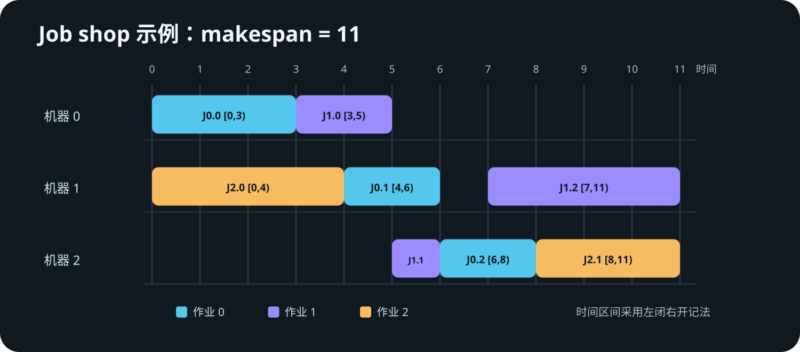
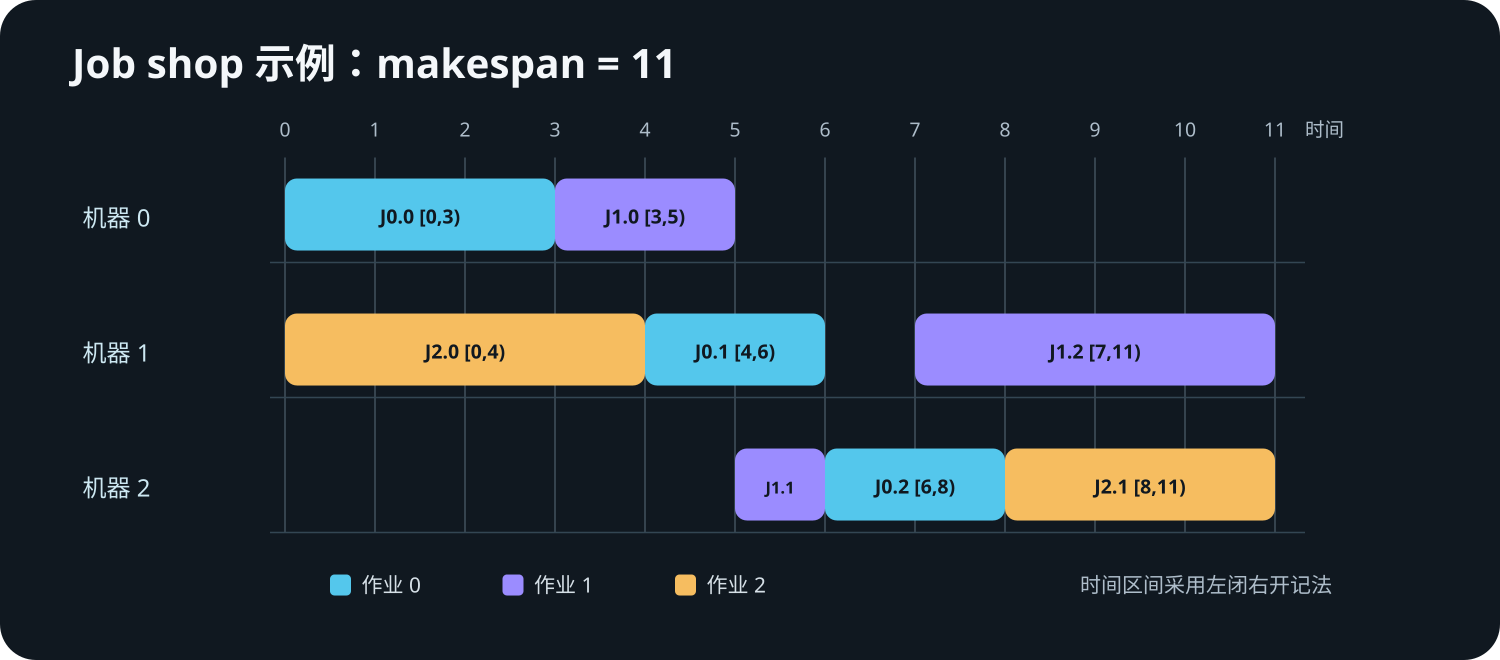
在来源示例中,页面先展示了一个长度为 12 的可行排程,随后求解器报告长度为 11 的解。页面给出的一种最优结果如下;区间用左闭右开语义表示,所以同一台机器上的前一道工序结束时,下一道可立即开始:
| 机器 | 作业与工序顺序 | 时间区间 |
|---|---|---|
| 0 | 作业 0 工序 0 → 作业 1 工序 0 | [0, 3) → [3, 5) |
| 1 | 作业 2 工序 0 → 作业 0 工序 1 → 作业 1 工序 2 | [0, 4) → [4, 6) → [7, 11) |
| 2 | 作业 1 工序 1 → 作业 0 工序 2 → 作业 2 工序 1 | [5, 6) → [6, 8) → [8, 11) |
作业 1 的最后一道工序在机器 1 上从时间 7 开始;把它提前到时间 6 也可满足约束,但不会让整体完工时间低于 11,因为其他作业仍在时间 11 才结束。因此最优排程可能不唯一。应检查每个作业的先后关系和同机区间是否冲突,而不是要求复现唯一的时间表。
正确报告求解器状态
CP-SAT 返回的 OPTIMAL 表示找到了满足约束的解并证明目标最优;FEASIBLE 只表示找到了可行解,可能尚未证明它最优。来源代码把两种状态都放进输出分支,却统一打印 “Optimal Schedule Length”。这是标签可能误导的状态处理问题。应分别报告状态:只有 OPTIMAL 才标记为已证明最优;FEASIBLE 应说当前可行方案,并附上界、求解时间或最优差距(若有)。其他状态不能把变量值当作有效排程直接打印。
实现边界与版本
页面给出 Python、C++、Java 和 C# 版本;建模顺序相同,但类名、方法命名和 API 形式不同。当前 Python 示例使用小写的 new_int_var、new_interval_var、add_no_overlap 和 solve 等方法,不要把较旧版本的 API 名称与当前代码混用。来源页最后更新于 2024 年 8 月 28 日,未固定完整发行版本;复制代码前要按所安装的 OR-Tools 版本核对 API 与 CP-SAT 文档。
模型来自网页中的小型内存数据,没有文件读写、shell 调用、凭据或外部输入处理;本稿不含可执行的完整程序。本次仅做静态审阅,没有安装 OR-Tools,也没有执行任何代码或示例、运行模型或基准测试;来源页展示的 11 个时间单位结果未经本稿独立验证。图表中的数值来自来源页展示的方案,不是本稿测试结果。
完整示例程序
以下 Python、C++、Java 和 C# 程序逐段转载自来源指南的完整示例,使用上文的三组作业和八道工序。官方页面说明正文为 CC BY 4.0、代码样例为 Apache License 2.0;此处保留代码原貌,去掉的只有网页代码块外层缩进。完整 Apache 2.0 许可文本见随稿的 LICENSE-APACHE-2.0.txt。本文没有执行这些程序,运行前应按实际 OR-Tools 版本核对 API。
阅读状态分支时请留意,上下文中已说明源码把 OPTIMAL 和 FEASIBLE 都打印为 “Optimal Schedule Length”;只有 OPTIMAL 表示已证明最优。C++ 源码首行保留了来源页面中提及 nurse scheduling 的注释,它与本例用途不一致,但不改变程序逻辑。
Python
"""Minimal jobshop example."""
import collections
from ortools.sat.python import cp_model


def main() -> None:
    """Minimal jobshop problem."""
    # Data.
    jobs_data = [  # task = (machine_id, processing_time).
        [(0, 3), (1, 2), (2, 2)],  # Job0
        [(0, 2), (2, 1), (1, 4)],  # Job1
        [(1, 4), (2, 3)],  # Job2
    ]

    machines_count = 1 + max(task[0] for job in jobs_data for task in job)
    all_machines = range(machines_count)
    # Computes horizon dynamically as the sum of all durations.
    horizon = sum(task[1] for job in jobs_data for task in job)

    # Create the model.
    model = cp_model.CpModel()

    # Named tuple to store information about created variables.
    task_type = collections.namedtuple("task_type", "start end interval")
    # Named tuple to manipulate solution information.
    assigned_task_type = collections.namedtuple(
        "assigned_task_type", "start job index duration"
    )

    # Creates job intervals and add to the corresponding machine lists.
    all_tasks = {}
    machine_to_intervals = collections.defaultdict(list)

    for job_id, job in enumerate(jobs_data):
        for task_id, task in enumerate(job):
            machine, duration = task
            suffix = f"_{job_id}_{task_id}"
            start_var = model.new_int_var(0, horizon, "start" + suffix)
            end_var = model.new_int_var(0, horizon, "end" + suffix)
            interval_var = model.new_interval_var(
                start_var, duration, end_var, "interval" + suffix
            )
            all_tasks[job_id, task_id] = task_type(
                start=start_var, end=end_var, interval=interval_var
            )
            machine_to_intervals[machine].append(interval_var)

    # Create and add disjunctive constraints.
    for machine in all_machines:
        model.add_no_overlap(machine_to_intervals[machine])

    # Precedences inside a job.
    for job_id, job in enumerate(jobs_data):
        for task_id in range(len(job) - 1):
            model.add(
                all_tasks[job_id, task_id + 1].start >= all_tasks[job_id, task_id].end
            )

    # Makespan objective.
    obj_var = model.new_int_var(0, horizon, "makespan")
    model.add_max_equality(
        obj_var,
        [all_tasks[job_id, len(job) - 1].end for job_id, job in enumerate(jobs_data)],
    )
    model.minimize(obj_var)

    # Creates the solver and solve.
    solver = cp_model.CpSolver()
    status = solver.solve(model)

    if status == cp_model.OPTIMAL or status == cp_model.FEASIBLE:
        print("Solution:")
        # Create one list of assigned tasks per machine.
        assigned_jobs = collections.defaultdict(list)
        for job_id, job in enumerate(jobs_data):
            for task_id, task in enumerate(job):
                machine = task[0]
                assigned_jobs[machine].append(
                    assigned_task_type(
                        start=solver.value(all_tasks[job_id, task_id].start),
                        job=job_id,
                        index=task_id,
                        duration=task[1],
                    )
                )
        # Create per machine output lines.
        output = ""
        for machine in all_machines:
            # Sort by starting time.
            assigned_jobs[machine].sort()
            sol_line_tasks = "Machine " + str(machine) + ": "
            sol_line = "           "

            for assigned_task in assigned_jobs[machine]:
                name = f"job_{assigned_task.job}_task_{assigned_task.index}"
                # add spaces to output to align columns.
                sol_line_tasks += f"{name:15}"

                start = assigned_task.start
                duration = assigned_task.duration
                sol_tmp = f"[{start},{start + duration}]"
                # add spaces to output to align columns.
                sol_line += f"{sol_tmp:15}"

            sol_line += "\n"
            sol_line_tasks += "\n"
            output += sol_line_tasks
            output += sol_line

        # Finally print the solution found.
        print(f"Optimal Schedule Length: {solver.objective_value}")
        print(output)
    else:
        print("No solution found.")

    # Statistics.
    print("\n Statistics")
    print(f"  - conflicts: {solver.num_conflicts}")
    print(f"  - branches : {solver.num_branches}")
    print(f"  - wall time: {solver.wall_time}s")


if __name__ == "__main__":
    main()
C++
// Nurse scheduling problem with shift requests.
#include <stdlib.h>

#include <algorithm>
#include <cstdint>
#include <map>
#include <numeric>
#include <string>
#include <tuple>
#include <vector>

#include "absl/base/log_severity.h"
#include "absl/log/globals.h"
#include "absl/strings/str_format.h"
#include "ortools/base/init_google.h"
#include "ortools/base/logging.h"
#include "ortools/sat/cp_model.h"
#include "ortools/sat/cp_model.pb.h"
#include "ortools/sat/cp_model_solver.h"

namespace operations_research {
namespace sat {

void MinimalJobshopSat() {
  using Task = std::tuple<int64_t, int64_t>;  // (machine_id, processing_time)
  using Job = std::vector<Task>;
  std::vector<Job> jobs_data = {
      {{0, 3}, {1, 2}, {2, 2}},  // Job_0: Task_0 Task_1 Task_2
      {{0, 2}, {2, 1}, {1, 4}},  // Job_1: Task_0 Task_1 Task_2
      {{1, 4}, {2, 3}},          // Job_2: Task_0 Task_1
  };

  int64_t num_machines = 0;
  for (const auto& job : jobs_data) {
    for (const auto& [machine, _] : job) {
      num_machines = std::max(num_machines, 1 + machine);
    }
  }

  std::vector<int> all_machines(num_machines);
  std::iota(all_machines.begin(), all_machines.end(), 0);

  // Computes horizon dynamically as the sum of all durations.
  int64_t horizon = 0;
  for (const auto& job : jobs_data) {
    for (const auto& [_, time] : job) {
      horizon += time;
    }
  }

  // Creates the model.
  CpModelBuilder cp_model;

  struct TaskType {
    IntVar start;
    IntVar end;
    IntervalVar interval;
  };

  using TaskID = std::tuple<int, int>;  // (job_id, task_id)
  std::map<TaskID, TaskType> all_tasks;
  std::map<int64_t, std::vector<IntervalVar>> machine_to_intervals;
  for (int job_id = 0; job_id < jobs_data.size(); ++job_id) {
    const auto& job = jobs_data[job_id];
    for (int task_id = 0; task_id < job.size(); ++task_id) {
      const auto [machine, duration] = job[task_id];
      std::string suffix = absl::StrFormat("_%d_%d", job_id, task_id);
      IntVar start = cp_model.NewIntVar({0, horizon})
                         .WithName(std::string("start") + suffix);
      IntVar end = cp_model.NewIntVar({0, horizon})
                       .WithName(std::string("end") + suffix);
      IntervalVar interval = cp_model.NewIntervalVar(start, duration, end)
                                 .WithName(std::string("interval") + suffix);

      TaskID key = std::make_tuple(job_id, task_id);
      all_tasks.emplace(key, TaskType{/*.start=*/start,
                                      /*.end=*/end,
                                      /*.interval=*/interval});
      machine_to_intervals[machine].push_back(interval);
    }
  }

  // Create and add disjunctive constraints.
  for (const auto machine : all_machines) {
    cp_model.AddNoOverlap(machine_to_intervals[machine]);
  }

  // Precedences inside a job.
  for (int job_id = 0; job_id < jobs_data.size(); ++job_id) {
    const auto& job = jobs_data[job_id];
    for (int task_id = 0; task_id < job.size() - 1; ++task_id) {
      TaskID key = std::make_tuple(job_id, task_id);
      TaskID next_key = std::make_tuple(job_id, task_id + 1);
      cp_model.AddGreaterOrEqual(all_tasks[next_key].start, all_tasks[key].end);
    }
  }

  // Makespan objective.
  IntVar obj_var = cp_model.NewIntVar({0, horizon}).WithName("makespan");

  std::vector<IntVar> ends;
  for (int job_id = 0; job_id < jobs_data.size(); ++job_id) {
    const auto& job = jobs_data[job_id];
    TaskID key = std::make_tuple(job_id, job.size() - 1);
    ends.push_back(all_tasks[key].end);
  }
  cp_model.AddMaxEquality(obj_var, ends);
  cp_model.Minimize(obj_var);

  const CpSolverResponse response = Solve(cp_model.Build());

  if (response.status() == CpSolverStatus::OPTIMAL ||
      response.status() == CpSolverStatus::FEASIBLE) {
    LOG(INFO) << "Solution:";
    // create one list of assigned tasks per machine.
    struct AssignedTaskType {
      int job_id;
      int task_id;
      int64_t start;
      int64_t duration;

      bool operator<(const AssignedTaskType& rhs) const {
        return std::tie(this->start, this->duration) <
               std::tie(rhs.start, rhs.duration);
      }
    };

    std::map<int64_t, std::vector<AssignedTaskType>> assigned_jobs;
    for (int job_id = 0; job_id < jobs_data.size(); ++job_id) {
      const auto& job = jobs_data[job_id];
      for (int task_id = 0; task_id < job.size(); ++task_id) {
        const auto [machine, duration] = job[task_id];
        TaskID key = std::make_tuple(job_id, task_id);
        int64_t start = SolutionIntegerValue(response, all_tasks[key].start);
        assigned_jobs[machine].push_back(
            AssignedTaskType{/*.job_id=*/job_id,
                             /*.task_id=*/task_id,
                             /*.start=*/start,
                             /*.duration=*/duration});
      }
    }

    // Create per machine output lines.
    std::string output = "";
    for (const auto machine : all_machines) {
      // Sort by starting time.
      std::sort(assigned_jobs[machine].begin(), assigned_jobs[machine].end());
      std::string sol_line_tasks = "Machine " + std::to_string(machine) + ": ";
      std::string sol_line = "           ";
      for (const auto& assigned_task : assigned_jobs[machine]) {
        std::string name = absl::StrFormat(
            "job_%d_task_%d", assigned_task.job_id, assigned_task.task_id);
        // Add spaces to output to align columns.
        sol_line_tasks += absl::StrFormat("%-15s", name);

        int64_t start = assigned_task.start;
        int64_t duration = assigned_task.duration;
        std::string sol_tmp =
            absl::StrFormat("[%i,%i]", start, start + duration);
        // Add spaces to output to align columns.
        sol_line += absl::StrFormat("%-15s", sol_tmp);
      }
      output += sol_line_tasks + "\n";
      output += sol_line + "\n";
    }
    // Finally print the solution found.
    LOG(INFO) << "Optimal Schedule Length: " << response.objective_value();
    LOG(INFO) << "\n" << output;
  } else {
    LOG(INFO) << "No solution found.";
  }

  // Statistics.
  LOG(INFO) << "Statistics";
  LOG(INFO) << CpSolverResponseStats(response);
}

}  // namespace sat
}  // namespace operations_research

int main(int argc, char* argv[]) {
  InitGoogle(argv[0], &argc, &argv, true);
  absl::SetStderrThreshold(absl::LogSeverityAtLeast::kInfo);
  operations_research::sat::MinimalJobshopSat();
  return EXIT_SUCCESS;
}
Java
package com.google.ortools.sat.samples;
import static java.lang.Math.max;

import com.google.ortools.Loader;
import com.google.ortools.sat.CpModel;
import com.google.ortools.sat.CpSolver;
import com.google.ortools.sat.CpSolverStatus;
import com.google.ortools.sat.IntVar;
import com.google.ortools.sat.IntervalVar;
import com.google.ortools.sat.LinearExpr;
import java.util.ArrayList;
import java.util.Arrays;
import java.util.Collections;
import java.util.Comparator;
import java.util.HashMap;
import java.util.List;
import java.util.Map;
import java.util.stream.IntStream;

/** Minimal Jobshop problem. */
public class MinimalJobshopSat {
  public static void main(String[] args) {
    Loader.loadNativeLibraries();
    class Task {
      int machine;
      int duration;
      Task(int machine, int duration) {
        this.machine = machine;
        this.duration = duration;
      }
    }

    final List<List<Task>> allJobs =
        Arrays.asList(Arrays.asList(new Task(0, 3), new Task(1, 2), new Task(2, 2)), // Job0
            Arrays.asList(new Task(0, 2), new Task(2, 1), new Task(1, 4)), // Job1
            Arrays.asList(new Task(1, 4), new Task(2, 3)) // Job2
        );

    int numMachines = 1;
    for (List<Task> job : allJobs) {
      for (Task task : job) {
        numMachines = max(numMachines, 1 + task.machine);
      }
    }
    final int[] allMachines = IntStream.range(0, numMachines).toArray();

    // Computes horizon dynamically as the sum of all durations.
    int horizon = 0;
    for (List<Task> job : allJobs) {
      for (Task task : job) {
        horizon += task.duration;
      }
    }

    // Creates the model.
    CpModel model = new CpModel();

    class TaskType {
      IntVar start;
      IntVar end;
      IntervalVar interval;
    }
    Map<List<Integer>, TaskType> allTasks = new HashMap<>();
    Map<Integer, List<IntervalVar>> machineToIntervals = new HashMap<>();

    for (int jobID = 0; jobID < allJobs.size(); ++jobID) {
      List<Task> job = allJobs.get(jobID);
      for (int taskID = 0; taskID < job.size(); ++taskID) {
        Task task = job.get(taskID);
        String suffix = "_" + jobID + "_" + taskID;
        TaskType taskType = new TaskType();
        taskType.start = model.newIntVar(0, horizon, "start" + suffix);
        taskType.end = model.newIntVar(0, horizon, "end" + suffix);
        taskType.interval = model.newIntervalVar(
            taskType.start, LinearExpr.constant(task.duration), taskType.end, "interval" + suffix);

        List<Integer> key = Arrays.asList(jobID, taskID);
        allTasks.put(key, taskType);
        machineToIntervals.computeIfAbsent(task.machine, (Integer k) -> new ArrayList<>());
        machineToIntervals.get(task.machine).add(taskType.interval);
      }
    }

    // Create and add disjunctive constraints.
    for (int machine : allMachines) {
      List<IntervalVar> list = machineToIntervals.get(machine);
      model.addNoOverlap(list);
    }

    // Precedences inside a job.
    for (int jobID = 0; jobID < allJobs.size(); ++jobID) {
      List<Task> job = allJobs.get(jobID);
      for (int taskID = 0; taskID < job.size() - 1; ++taskID) {
        List<Integer> prevKey = Arrays.asList(jobID, taskID);
        List<Integer> nextKey = Arrays.asList(jobID, taskID + 1);
        model.addGreaterOrEqual(allTasks.get(nextKey).start, allTasks.get(prevKey).end);
      }
    }

    // Makespan objective.
    IntVar objVar = model.newIntVar(0, horizon, "makespan");
    List<IntVar> ends = new ArrayList<>();
    for (int jobID = 0; jobID < allJobs.size(); ++jobID) {
      List<Task> job = allJobs.get(jobID);
      List<Integer> key = Arrays.asList(jobID, job.size() - 1);
      ends.add(allTasks.get(key).end);
    }
    model.addMaxEquality(objVar, ends);
    model.minimize(objVar);

    // Creates a solver and solves the model.
    CpSolver solver = new CpSolver();
    CpSolverStatus status = solver.solve(model);
    if (status == CpSolverStatus.OPTIMAL || status == CpSolverStatus.FEASIBLE) {
      class AssignedTask {
        int jobID;
        int taskID;
        int start;
        int duration;
        // Ctor
        AssignedTask(int jobID, int taskID, int start, int duration) {
          this.jobID = jobID;
          this.taskID = taskID;
          this.start = start;
          this.duration = duration;
        }
      }
      class SortTasks implements Comparator<AssignedTask> {
        @Override
        public int compare(AssignedTask a, AssignedTask b) {
          if (a.start != b.start) {
            return a.start - b.start;
          } else {
            return a.duration - b.duration;
          }
        }
      }
      System.out.println("Solution:");
      // Create one list of assigned tasks per machine.
      Map<Integer, List<AssignedTask>> assignedJobs = new HashMap<>();
      for (int jobID = 0; jobID < allJobs.size(); ++jobID) {
        List<Task> job = allJobs.get(jobID);
        for (int taskID = 0; taskID < job.size(); ++taskID) {
          Task task = job.get(taskID);
          List<Integer> key = Arrays.asList(jobID, taskID);
          AssignedTask assignedTask = new AssignedTask(
              jobID, taskID, (int) solver.value(allTasks.get(key).start), task.duration);
          assignedJobs.computeIfAbsent(task.machine, (Integer k) -> new ArrayList<>());
          assignedJobs.get(task.machine).add(assignedTask);
        }
      }

      // Create per machine output lines.
      String output = "";
      for (int machine : allMachines) {
        // Sort by starting time.
        Collections.sort(assignedJobs.get(machine), new SortTasks());
        String solLineTasks = "Machine " + machine + ": ";
        String solLine = "           ";

        for (AssignedTask assignedTask : assignedJobs.get(machine)) {
          String name = "job_" + assignedTask.jobID + "_task_" + assignedTask.taskID;
          // Add spaces to output to align columns.
          solLineTasks += String.format("%-15s", name);

          String solTmp =
              "[" + assignedTask.start + "," + (assignedTask.start + assignedTask.duration) + "]";
          // Add spaces to output to align columns.
          solLine += String.format("%-15s", solTmp);
        }
        output += solLineTasks + "%n";
        output += solLine + "%n";
      }
      System.out.printf("Optimal Schedule Length: %f%n", solver.objectiveValue());
      System.out.printf(output);
    } else {
      System.out.println("No solution found.");
    }

    // Statistics.
    System.out.println("Statistics");
    System.out.printf("  conflicts: %d%n", solver.numConflicts());
    System.out.printf("  branches : %d%n", solver.numBranches());
    System.out.printf("  wall time: %f s%n", solver.wallTime());
  }

  private MinimalJobshopSat() {}
}
C#
using System;
using System.Collections;
using System.Collections.Generic;
using System.Linq;
using Google.OrTools.Sat;

public class ScheduleRequestsSat
{
    private class AssignedTask : IComparable
    {
        public int jobID;
        public int taskID;
        public int start;
        public int duration;

        public AssignedTask(int jobID, int taskID, int start, int duration)
        {
            this.jobID = jobID;
            this.taskID = taskID;
            this.start = start;
            this.duration = duration;
        }

        public int CompareTo(object obj)
        {
            if (obj == null)
                return 1;

            AssignedTask otherTask = obj as AssignedTask;
            if (otherTask != null)
            {
                if (this.start != otherTask.start)
                    return this.start.CompareTo(otherTask.start);
                else
                    return this.duration.CompareTo(otherTask.duration);
            }
            else
                throw new ArgumentException("Object is not a Temperature");
        }
    }

    public static void Main(String[] args)
    {
        var allJobs =
            new[] {
                new[] {
                    // job0
                    new { machine = 0, duration = 3 }, // task0
                    new { machine = 1, duration = 2 }, // task1
                    new { machine = 2, duration = 2 }, // task2
                }
                    .ToList(),
                new[] {
                    // job1
                    new { machine = 0, duration = 2 }, // task0
                    new { machine = 2, duration = 1 }, // task1
                    new { machine = 1, duration = 4 }, // task2
                }
                    .ToList(),
                new[] {
                    // job2
                    new { machine = 1, duration = 4 }, // task0
                    new { machine = 2, duration = 3 }, // task1
                }
                    .ToList(),
            }
                .ToList();

        int numMachines = 0;
        foreach (var job in allJobs)
        {
            foreach (var task in job)
            {
                numMachines = Math.Max(numMachines, 1 + task.machine);
            }
        }
        int[] allMachines = Enumerable.Range(0, numMachines).ToArray();

        // Computes horizon dynamically as the sum of all durations.
        int horizon = 0;
        foreach (var job in allJobs)
        {
            foreach (var task in job)
            {
                horizon += task.duration;
            }
        }

        // Creates the model.
        CpModel model = new CpModel();

        Dictionary<Tuple<int, int>, Tuple<IntVar, IntVar, IntervalVar>> allTasks =
            new Dictionary<Tuple<int, int>, Tuple<IntVar, IntVar, IntervalVar>>(); // (start, end, duration)
        Dictionary<int, List<IntervalVar>> machineToIntervals = new Dictionary<int, List<IntervalVar>>();
        for (int jobID = 0; jobID < allJobs.Count(); ++jobID)
        {
            var job = allJobs[jobID];
            for (int taskID = 0; taskID < job.Count(); ++taskID)
            {
                var task = job[taskID];
                String suffix = $"_{jobID}_{taskID}";
                IntVar start = model.NewIntVar(0, horizon, "start" + suffix);
                IntVar end = model.NewIntVar(0, horizon, "end" + suffix);
                IntervalVar interval = model.NewIntervalVar(start, task.duration, end, "interval" + suffix);
                var key = Tuple.Create(jobID, taskID);
                allTasks[key] = Tuple.Create(start, end, interval);
                if (!machineToIntervals.ContainsKey(task.machine))
                {
                    machineToIntervals.Add(task.machine, new List<IntervalVar>());
                }
                machineToIntervals[task.machine].Add(interval);
            }
        }

        // Create and add disjunctive constraints.
        foreach (int machine in allMachines)
        {
            model.AddNoOverlap(machineToIntervals[machine]);
        }

        // Precedences inside a job.
        for (int jobID = 0; jobID < allJobs.Count(); ++jobID)
        {
            var job = allJobs[jobID];
            for (int taskID = 0; taskID < job.Count() - 1; ++taskID)
            {
                var key = Tuple.Create(jobID, taskID);
                var nextKey = Tuple.Create(jobID, taskID + 1);
                model.Add(allTasks[nextKey].Item1 >= allTasks[key].Item2);
            }
        }

        // Makespan objective.
        IntVar objVar = model.NewIntVar(0, horizon, "makespan");

        List<IntVar> ends = new List<IntVar>();
        for (int jobID = 0; jobID < allJobs.Count(); ++jobID)
        {
            var job = allJobs[jobID];
            var key = Tuple.Create(jobID, job.Count() - 1);
            ends.Add(allTasks[key].Item2);
        }
        model.AddMaxEquality(objVar, ends);
        model.Minimize(objVar);

        // Solve
        CpSolver solver = new CpSolver();
        CpSolverStatus status = solver.Solve(model);
        Console.WriteLine($"Solve status: {status}");

        if (status == CpSolverStatus.Optimal || status == CpSolverStatus.Feasible)
        {
            Console.WriteLine("Solution:");

            Dictionary<int, List<AssignedTask>> assignedJobs = new Dictionary<int, List<AssignedTask>>();
            for (int jobID = 0; jobID < allJobs.Count(); ++jobID)
            {
                var job = allJobs[jobID];
                for (int taskID = 0; taskID < job.Count(); ++taskID)
                {
                    var task = job[taskID];
                    var key = Tuple.Create(jobID, taskID);
                    int start = (int)solver.Value(allTasks[key].Item1);
                    if (!assignedJobs.ContainsKey(task.machine))
                    {
                        assignedJobs.Add(task.machine, new List<AssignedTask>());
                    }
                    assignedJobs[task.machine].Add(new AssignedTask(jobID, taskID, start, task.duration));
                }
            }

            // Create per machine output lines.
            String output = "";
            foreach (int machine in allMachines)
            {
                // Sort by starting time.
                assignedJobs[machine].Sort();
                String solLineTasks = $"Machine {machine}: ";
                String solLine = "           ";

                foreach (var assignedTask in assignedJobs[machine])
                {
                    String name = $"job_{assignedTask.jobID}_task_{assignedTask.taskID}";
                    // Add spaces to output to align columns.
                    solLineTasks += $"{name,-15}";

                    String solTmp = $"[{assignedTask.start},{assignedTask.start+assignedTask.duration}]";
                    // Add spaces to output to align columns.
                    solLine += $"{solTmp,-15}";
                }
                output += solLineTasks + "\n";
                output += solLine + "\n";
            }
            // Finally print the solution found.
            Console.WriteLine($"Optimal Schedule Length: {solver.ObjectiveValue}");
            Console.WriteLine($"\n{output}");
        }
        else
        {
            Console.WriteLine("No solution found.");
        }

        Console.WriteLine("Statistics");
        Console.WriteLine($"  conflicts: {solver.NumConflicts()}");
        Console.WriteLine($"  branches : {solver.NumBranches()}");
        Console.WriteLine($"  wall time: {solver.WallTime()}s");
    }
}








暂无评论内容