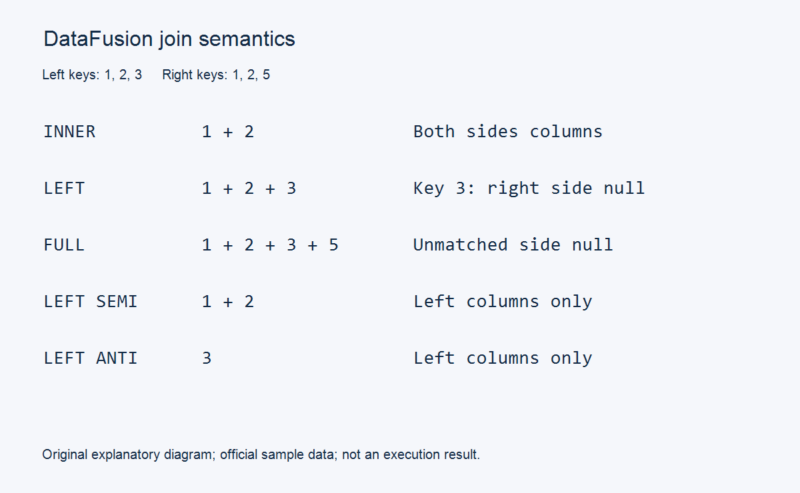



把客户表与服务商表拼在一起,难点往往不是写出一次连接,而是明确三件事:没有匹配的行要不要保留,结果需要哪一侧的列,以及两边同名的列究竟指向谁。DataFusion Python 的 join() 支持内连接、左连接、右连接、全连接、左半连接和左反连接。本文按照官方指南的全部示例,逐一说明这些选择,并处理 51.0.0 之后连接键合并行为的变化。
原文:Apache DataFusion Python 官方文档 Joins。原页未署个人作者,维护方为 Apache Software Foundation。本文为经授权的中文翻译整理,核验日期为 2026 年 10 月 5 日。以下表格是原文示例结果的整理,不是本文运行得到的输出;没有显式排序时,不应依赖行的展示顺序。
先准备两张小表
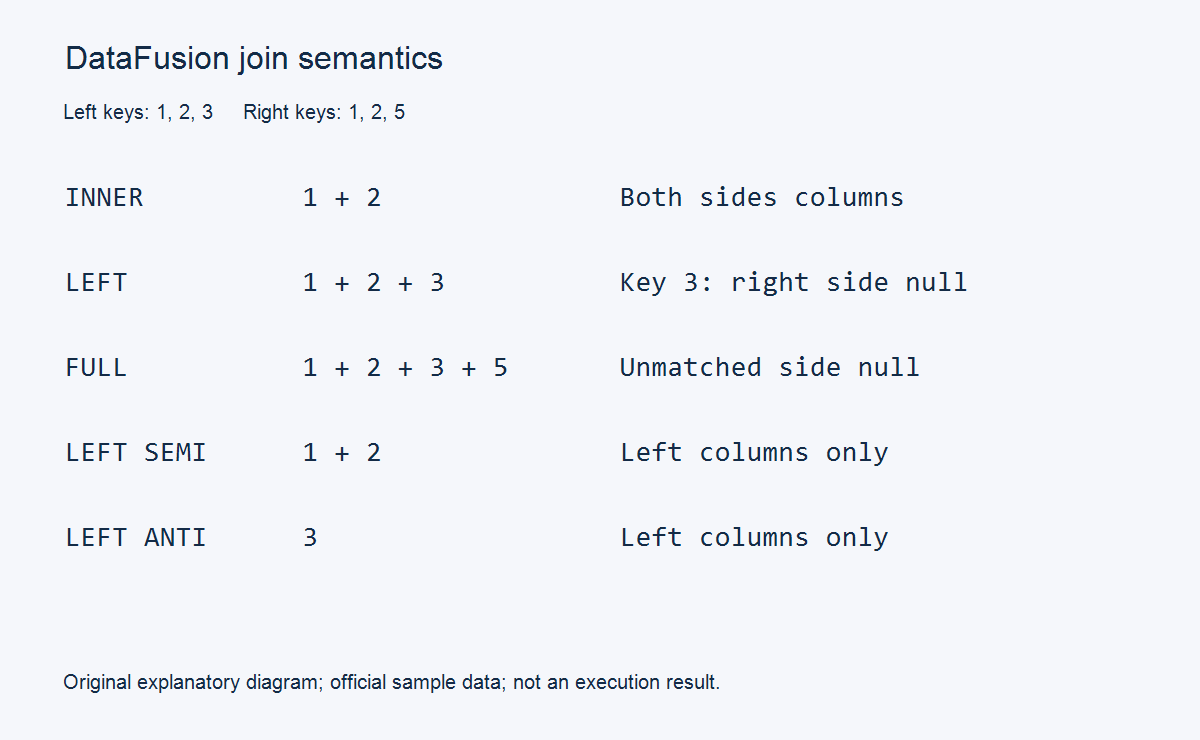
左表有三位客户,连接键叫 customer_id;右表有三家服务商,连接键叫 id。键值 1、2 同时出现在两张表里,3 只在左表,5 只在右表。这样一组数据足以看清“匹配”和“保留未匹配行”的区别。
from datafusion import SessionContext

ctx = SessionContext()

left = ctx.from_pydict(
    {
        "customer_id": [1, 2, 3],
        "customer": ["Alice", "Bob", "Charlie"],
    }
)

right = ctx.from_pylist([
    {"id": 1, "name": "CityCabs"},
    {"id": 2, "name": "MetroRide"},
    {"id": 5, "name": "UrbanGo"},
])
内连接:只留下双方都有的键
内连接只保留连接键能够匹配的行。因此 Alice 与 CityCabs 配对,Bob 与 MetroRide 配对;Charlie 和 UrbanGo 都不进入结果。两侧连接键的名字不同,用 left_on 和 right_on 分别指定。
left.join(right, left_on="customer_id", right_on="id", how="inner")| customer_id | customer | id | name |
|---|---|---|---|
| 1 | Alice | 1 | CityCabs |
| 2 | Bob | 2 | MetroRide |
原文此处还用 join_keys 解释“分别指定两侧待匹配列”的概念,但实际示例采用的是 left_on、right_on。本文保留可直接对应示例的参数写法,不将那句说明当作另一个已验证的调用。
左连接:保留所有客户,缺失匹配用 null 表示
左连接保留左表的每一行,并附上右表中匹配的数据。Charlie 找不到服务商,仍然出现在结果里,但右侧的 id 与 name 为空。这里的空值是 null,不是数字 0,也不是空字符串。
left.join(right, left_on="customer_id", right_on="id", how="left")| customer_id | customer | id | name |
|---|---|---|---|
| 1 | Alice | 1 | CityCabs |
| 2 | Bob | 2 | MetroRide |
| 3 | Charlie | null | null |
官方页的支持列表也包含右连接。其保留方向与左连接相反:以右表为完整保留的一侧。原页没有单独给出右连接的代码与结果,本文也不额外伪造一组官方输出。
全连接:两侧未匹配的数据都留下
全连接把两张表中的行都纳入结果。有匹配的行合并成一行;只存在于一侧的行,另一侧的列填 null。它适合同时检查“客户没有服务商”和“服务商没有客户”这两类缺口。
left.join(right, left_on="customer_id", right_on="id", how="full")| customer_id | customer | id | name |
|---|---|---|---|
| 1 | Alice | 1 | CityCabs |
| 2 | Bob | 2 | MetroRide |
| null | null | 5 | UrbanGo |
| 3 | Charlie | null | null |
左半连接:只问是否匹配,不带入右表列
左半连接留下左表中至少能在右表找到一次匹配的行,输出仍然只有左表的列。右表即便有多个匹配,也不会因为这些右侧匹配而重复扩展同一条左侧记录。这不等于对左表本身做去重;它解决的是“存在匹配就保留”的筛选需求。
left.join(right, left_on="customer_id", right_on="id", how="semi")| customer_id | customer |
|---|---|
| 1 | Alice |
| 2 | Bob |
左反连接:找出完全没有匹配的左表行
左反连接保留左表里找不到任何右侧匹配的行。一旦某条左表记录至少有一个匹配,它就会被排除。示例中只有 Charlie 符合条件,输出也只包含左表列。
left.join(right, left_on="customer_id", right_on="id", how="anti")| customer_id | customer |
|---|---|
| 3 | Charlie |
由此可以把选择标准说得很具体:需要两边的字段并只看匹配项,用内连接;要完整保留一侧,用对应方向的外连接;要看双方的缺口,用全连接;只根据右表是否存在匹配来筛左表,用半连接或反连接。
同名连接键:51.0.0 起默认合并
接下来将左表的连接键也改为 id。这里讨论的“重复键”是连接结果中两个键列名字相同,并不是说输入中出现了重复键值。从 datafusion-python 51.0.0 开始,默认会合并两侧同名的连接键,减少后续选列的歧义。
left = ctx.from_pydict(
    {
        "id": [1, 2, 3],
        "customer": ["Alice", "Bob", "Charlie"],
    }
)

right = ctx.from_pylist([
    {"id": 1, "name": "CityCabs"},
    {"id": 2, "name": "MetroRide"},
    {"id": 5, "name": "UrbanGo"},
])

left.join(right, "id", how="inner")| id | customer | name |
|---|---|---|
| 1 | Alice | CityCabs |
| 2 | Bob | MetroRide |
如果确实需要保留两侧的键列,将 coalesce_duplicate_keys 显式设为 False:
left.join(right, "id", how="inner", coalesce_duplicate_keys=False)| id(左) | customer | id(右) | name |
|---|---|---|---|
| 1 | Alice | 1 | CityCabs |
| 2 | Bob | 2 | MetroRide |
上表中的“左”“右”是为了阅读而加的说明;原始结果的两个列名都叫 id,不会因为关闭合并而自动获得本文的标签。升级旧项目时,应检查后续选择列的逻辑是否依赖过去存在两个同名键列的行为。
同名的普通列:通过 DataFrame.col() 指明来源
连接键之外,两张表也可能各自有一列 val。这时仅凭列名无法表达想要哪一侧的数据。应在连接前,通过各自 DataFrame 的 col() 取得带来源限定的列引用,再把这些引用用于连接条件与结果投影。接受表达式条件的 join_on() 很适合这种写法。
left = ctx.from_pydict(
    {
        "id": [1, 2, 3],
        "val": [10, 20, 30],
    }
)

right = ctx.from_pydict(
    {
        "id": [1, 2, 3],
        "val": [40, 50, 60],
    }
)

joined = left.join_on(
    right, left.col("id") == right.col("id"), how="inner"
)

joined.select(left.col("id"), left.col("val"), right.col("val"))| id | val(左) | val(右) |
|---|---|---|
| 1 | 10 | 40 |
| 2 | 20 | 50 |
| 3 | 30 | 60 |
这里限定的是表达式指向的来源。原文结果仍然显示两个 val 列,并未自动重命名。上表再次用括号标出来源,仅为避免读者混淆。实际整理下游数据时,可以另行制定清晰的字段命名,但不要把同名键默认合并误解为所有同名普通列都会自动消歧。
本文只静态检查了代码的参数、字段对应关系和结果语义,没有安装或运行 DataFusion。示例只使用内存中的常量数据,没有凭据、拼接 SQL 或破坏性操作;这项检查也不意味着已完成安全审计。将示例迁移到真实数据时,还应单独核对输入中重复键值、空连接键、数据类型和排序要求,它们并未由这组小表覆盖。
原始版权与许可
Apache DataFusion Python 文档及示例采用 Apache License 2.0;中文翻译与技术整理已在正文标示。 官方许可来源
                                 Apache License
                           Version 2.0, January 2004
                        http://www.apache.org/licenses/

   TERMS AND CONDITIONS FOR USE, REPRODUCTION, AND DISTRIBUTION

   1. Definitions.

      "License" shall mean the terms and conditions for use, reproduction,
      and distribution as defined by Sections 1 through 9 of this document.

      "Licensor" shall mean the copyright owner or entity authorized by
      the copyright owner that is granting the License.

      "Legal Entity" shall mean the union of the acting entity and all
      other entities that control, are controlled by, or are under common
      control with that entity. For the purposes of this definition,
      "control" means (i) the power, direct or indirect, to cause the
      direction or management of such entity, whether by contract or
      otherwise, or (ii) ownership of fifty percent (50%) or more of the
      outstanding shares, or (iii) beneficial ownership of such entity.

      "You" (or "Your") shall mean an individual or Legal Entity
      exercising permissions granted by this License.

      "Source" form shall mean the preferred form for making modifications,
      including but not limited to software source code, documentation
      source, and configuration files.

      "Object" form shall mean any form resulting from mechanical
      transformation or translation of a Source form, including but
      not limited to compiled object code, generated documentation,
      and conversions to other media types.

      "Work" shall mean the work of authorship, whether in Source or
      Object form, made available under the License, as indicated by a
      copyright notice that is included in or attached to the work
      (an example is provided in the Appendix below).

      "Derivative Works" shall mean any work, whether in Source or Object
      form, that is based on (or derived from) the Work and for which the
      editorial revisions, annotations, elaborations, or other modifications
      represent, as a whole, an original work of authorship. For the purposes
      of this License, Derivative Works shall not include works that remain
      separable from, or merely link (or bind by name) to the interfaces of,
      the Work and Derivative Works thereof.

      "Contribution" shall mean any work of authorship, including
      the original version of the Work and any modifications or additions
      to that Work or Derivative Works thereof, that is intentionally
      submitted to Licensor for inclusion in the Work by the copyright owner
      or by an individual or Legal Entity authorized to submit on behalf of
      the copyright owner. For the purposes of this definition, "submitted"
      means any form of electronic, verbal, or written communication sent
      to the Licensor or its representatives, including but not limited to
      communication on electronic mailing lists, source code control systems,
      and issue tracking systems that are managed by, or on behalf of, the
      Licensor for the purpose of discussing and improving the Work, but
      excluding communication that is conspicuously marked or otherwise
      designated in writing by the copyright owner as "Not a Contribution."

      "Contributor" shall mean Licensor and any individual or Legal Entity
      on behalf of whom a Contribution has been received by Licensor and
      subsequently incorporated within the Work.

   2. Grant of Copyright License. Subject to the terms and conditions of
      this License, each Contributor hereby grants to You a perpetual,
      worldwide, non-exclusive, no-charge, royalty-free, irrevocable
      copyright license to reproduce, prepare Derivative Works of,
      publicly display, publicly perform, sublicense, and distribute the
      Work and such Derivative Works in Source or Object form.

   3. Grant of Patent License. Subject to the terms and conditions of
      this License, each Contributor hereby grants to You a perpetual,
      worldwide, non-exclusive, no-charge, royalty-free, irrevocable
      (except as stated in this section) patent license to make, have made,
      use, offer to sell, sell, import, and otherwise transfer the Work,
      where such license applies only to those patent claims licensable
      by such Contributor that are necessarily infringed by their
      Contribution(s) alone or by combination of their Contribution(s)
      with the Work to which such Contribution(s) was submitted. If You
      institute patent litigation against any entity (including a
      cross-claim or counterclaim in a lawsuit) alleging that the Work
      or a Contribution incorporated within the Work constitutes direct
      or contributory patent infringement, then any patent licenses
      granted to You under this License for that Work shall terminate
      as of the date such litigation is filed.

   4. Redistribution. You may reproduce and distribute copies of the
      Work or Derivative Works thereof in any medium, with or without
      modifications, and in Source or Object form, provided that You
      meet the following conditions:

      (a) You must give any other recipients of the Work or
          Derivative Works a copy of this License; and

      (b) You must cause any modified files to carry prominent notices
          stating that You changed the files; and

      (c) You must retain, in the Source form of any Derivative Works
          that You distribute, all copyright, patent, trademark, and
          attribution notices from the Source form of the Work,
          excluding those notices that do not pertain to any part of
          the Derivative Works; and

      (d) If the Work includes a "NOTICE" text file as part of its
          distribution, then any Derivative Works that You distribute must
          include a readable copy of the attribution notices contained
          within such NOTICE file, excluding those notices that do not
          pertain to any part of the Derivative Works, in at least one
          of the following places: within a NOTICE text file distributed
          as part of the Derivative Works; within the Source form or
          documentation, if provided along with the Derivative Works; or,
          within a display generated by the Derivative Works, if and
          wherever such third-party notices normally appear. The contents
          of the NOTICE file are for informational purposes only and
          do not modify the License. You may add Your own attribution
          notices within Derivative Works that You distribute, alongside
          or as an addendum to the NOTICE text from the Work, provided
          that such additional attribution notices cannot be construed
          as modifying the License.

      You may add Your own copyright statement to Your modifications and
      may provide additional or different license terms and conditions
      for use, reproduction, or distribution of Your modifications, or
      for any such Derivative Works as a whole, provided Your use,
      reproduction, and distribution of the Work otherwise complies with
      the conditions stated in this License.

   5. Submission of Contributions. Unless You explicitly state otherwise,
      any Contribution intentionally submitted for inclusion in the Work
      by You to the Licensor shall be under the terms and conditions of
      this License, without any additional terms or conditions.
      Notwithstanding the above, nothing herein shall supersede or modify
      the terms of any separate license agreement you may have executed
      with Licensor regarding such Contributions.

   6. Trademarks. This License does not grant permission to use the trade
      names, trademarks, service marks, or product names of the Licensor,
      except as required for reasonable and customary use in describing the
      origin of the Work and reproducing the content of the NOTICE file.

   7. Disclaimer of Warranty. Unless required by applicable law or
      agreed to in writing, Licensor provides the Work (and each
      Contributor provides its Contributions) on an "AS IS" BASIS,
      WITHOUT WARRANTIES OR CONDITIONS OF ANY KIND, either express or
      implied, including, without limitation, any warranties or conditions
      of TITLE, NON-INFRINGEMENT, MERCHANTABILITY, or FITNESS FOR A
      PARTICULAR PURPOSE. You are solely responsible for determining the
      appropriateness of using or redistributing the Work and assume any
      risks associated with Your exercise of permissions under this License.

   8. Limitation of Liability. In no event and under no legal theory,
      whether in tort (including negligence), contract, or otherwise,
      unless required by applicable law (such as deliberate and grossly
      negligent acts) or agreed to in writing, shall any Contributor be
      liable to You for damages, including any direct, indirect, special,
      incidental, or consequential damages of any character arising as a
      result of this License or out of the use or inability to use the
      Work (including but not limited to damages for loss of goodwill,
      work stoppage, computer failure or malfunction, or any and all
      other commercial damages or losses), even if such Contributor
      has been advised of the possibility of such damages.

   9. Accepting Warranty or Additional Liability. While redistributing
      the Work or Derivative Works thereof, You may choose to offer,
      and charge a fee for, acceptance of support, warranty, indemnity,
      or other liability obligations and/or rights consistent with this
      License. However, in accepting such obligations, You may act only
      on Your own behalf and on Your sole responsibility, not on behalf
      of any other Contributor, and only if You agree to indemnify,
      defend, and hold each Contributor harmless for any liability
      incurred by, or claims asserted against, such Contributor by reason
      of your accepting any such warranty or additional liability.

   END OF TERMS AND CONDITIONS

   APPENDIX: How to apply the Apache License to your work.

      To apply the Apache License to your work, attach the following
      boilerplate notice, with the fields enclosed by brackets "[]"
      replaced with your own identifying information. (Don't include
      the brackets!)  The text should be enclosed in the appropriate
      comment syntax for the file format. We also recommend that a
      file or class name and description of purpose be included on the
      same "printed page" as the copyright notice for easier
      identification within third-party archives.

   Copyright [yyyy] [name of copyright owner]

   Licensed under the Apache License, Version 2.0 (the "License");
   you may not use this file except in compliance with the License.
   You may obtain a copy of the License at

       http://www.apache.org/licenses/LICENSE-2.0

   Unless required by applicable law or agreed to in writing, software
   distributed under the License is distributed on an "AS IS" BASIS,
   WITHOUT WARRANTIES OR CONDITIONS OF ANY KIND, either express or implied.
   See the License for the specific language governing permissions and
   limitations under the License.



暂无评论内容