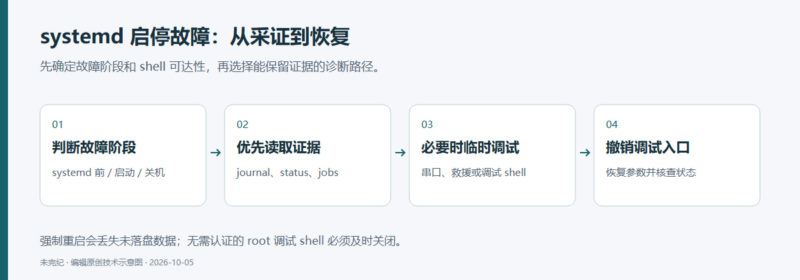



机器在启动时停住,首先要弄清楚:控制权是否已经交给 systemd?如果故障发生在更早的阶段,排查方向就不同;如果 systemd 已经运行,则应尽量取得 shell,读取它正在等待的任务和留下的日志。
本文完整翻译 systemd 官方诊断指南的主要流程与命令,并把涉及真实系统状态的操作标在上下文中。原文是滚动文档,仍含2012年的输出格式和发行版相关路径;这里保留这些信息,同时说明它们的适用边界。所有命令都只作静态审阅,本次未修改任何系统服务、安全设置或启动参数。
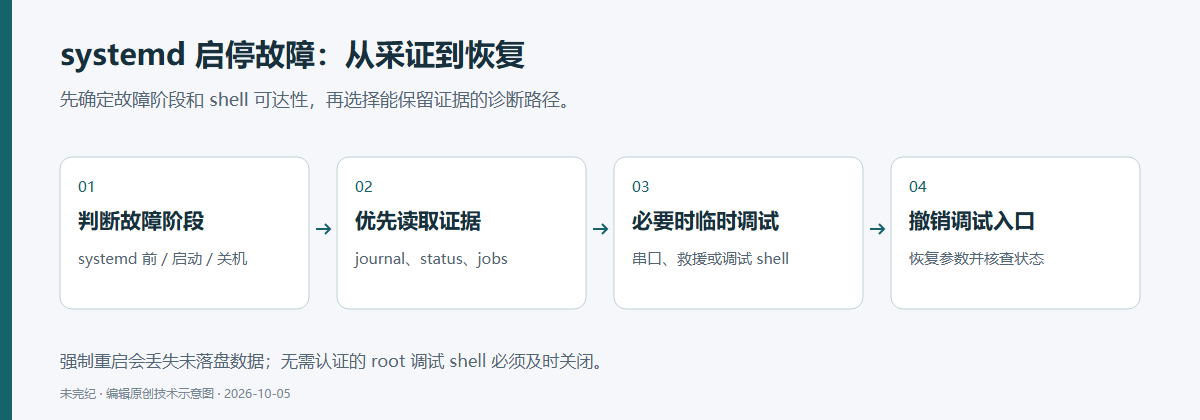
先确认 systemd 是否已经运行
可在下一次启动时临时去掉内核命令行中的 rhgb 和 quiet,让启动信息显示出来。如果看到了类似“Welcome to Fedora VERSION (codename)!”、“Starting name…”或“[ OK ] Started name.”的消息,就说明 systemd 已经开始工作。rhgb 及 Fedora 提示属于原文所用发行版的示例,不是所有 Linux 系统的共同界面。原文还提供了一张历史启动截图供对照。
如果没有登录提示,试着按 Ctrl+Alt+相应功能键切换虚拟终端。显示服务器启动故障可能让 tty1 没有可用登录界面,但其他虚拟终端仍然可用。
当所有虚拟控制台都没有登录提示时,原文建议先等最多约5分钟,再判断是否确实卡死。某个启动失败的服务可能在超时后被终止,随后启动继续;某个重要挂载点所需设备一直不出现,也可能最终触发 emergency 模式。这是诊断等待建议,并不意味着所有服务或所有版本都使用5分钟超时。
完全拿不到 shell 时
如果普通登录和 emergency shell 都不可用,需要换一种方式把诊断信息导出。可以先观察 Ctrl+Alt+Del 是否能重启;若没有反应,将这一现象记入问题报告。原文还提到 SysRq 或硬复位作为最后手段。强制复位可能造成未落盘数据丢失或文件系统损坏,只应在受控维护场景中使用,不能把它当作日常排障的第一步。
下一次启动时,根据所选诊断方式临时添加相应内核命令行参数。修改前先保留原参数和可用的回退启动项。
把调试日志送到串口控制台
若有硬件串口,或在虚拟机中有可连接的串口控制台,可以让 systemd 输出详细日志。以 virt-manager 为例,可从 View → Text Consoles 切换,或使用 virsh console MACHINE。原文给出的参数为:
systemd.log_level=debug systemd.log_target=console console=ttyS0,38400 console=tty1这组参数适合观察 PID 1 自身的失败。若出问题的是较晚启动但很关键的服务,例如网络服务,则可以让 journald 把日志转发到控制台:
systemd.journald.forward_to_console=1 console=ttyS0,38400 console=tty1console= 可以出现多次;原文使用 ttyS0、38400波特率和 tty1。应按实际串口设备和终端配置调整,不能把这里的设备名与速率当作通用值。大量调试日志还可能改变时序,记录复现条件时应注明。
进入 rescue 或 emergency 目标
在内核命令行中加入 systemd.unit=rescue.target,或者简写 1,可以直接进入 rescue 目标。它适合基本系统已经建立、启动普通服务时才发生的问题;在那里可以调查并按需要禁用有故障的服务。如果 rescue 也启动不了,可以尝试更精简的 emergency 目标。
加入 systemd.unit=emergency.target 或 emergency 可进入 emergency shell。原文提醒,在这个环境中编辑文件之前,可能需要自行把根文件系统重新挂载为可写:
mount -o remount,rw /编辑补充:这条命令会改变根文件系统的挂载状态,应先确认根文件系统确实适合写入;如果怀疑存在损坏,优先按文件系统及发行版恢复流程处理。常见可排查问题是 /etc/fstab 中的错误条目。确认并修复后,运行 systemctl daemon-reload,使 systemd 重新读取由此产生的配置。
如果连 emergency 目标都不可用,原文建议用 init=/bin/sh 直接启动 shell;当 systemd 本身或其依赖库因文件系统损坏而不可用时,这可能有帮助,并可能需要重新安装受影响的软件包。如果它也不起作用,就需要从其他介质启动。上述路径都属于系统恢复操作,需确保有受控的控制台和恢复介质。
临时启用早期调试 shell
调试 shell 可以在启动很早的阶段就提供访问入口,供人使用 systemctl 查询状态、读取日志、执行 systemctl list-jobs 等诊断操作。原文给出两种启用方式:
systemctl enable debug-shell.service或者在内核命令行加入:
systemd.debug_shell=1如果无法通过 systemctl 与运行中的管理器通信,例如正在另一个已启动的系统中准备恢复,可以使用 --root=,使操作针对指定文件系统树而无需联系该管理器:
systemctl --root=/ enable debug-shell.service这里的 / 是原文示例。在救援系统中处理另一个已挂载的系统时,必须换成那个目标系统的挂载根目录;否则可能修改救援系统自身的配置。下一次启动后,通常可按 Ctrl+Alt+F9 切换到 tty9,使用早期就存在的 root shell。
此入口有明确的安全风险:它提供无需普通登录认证的 root shell,只能短时用于调试。完成后要停止并禁用实际启用的服务,还要移除临时内核参数。原文警告段写成了 systemd-debug-shell.service,但前面的启用命令为 debug-shell.service;这里按启用命令给出一致的撤销示例,并要求先核对本机单元名:
systemctl disable --now debug-shell.service
systemctl is-enabled debug-shell.service
systemctl is-active debug-shell.service
以上为编辑补充:检查结果应与已禁用、已停止的目标状态一致。若入口来自 systemd.debug_shell=1,还必须从启动项移除该参数,并在之后的正常启动中确认入口没有再次出现。原文还提到把 kbrequest.target 关联到 debug-shell.service,以按需启动;它能避免一直运行 shell,但并不会消除 root 入口的风险。
核对内核与设备前提
systemd 需要至少部分已建立的 /dev。在嵌入式等自行配置内核的环境中,原文建议检查 CONFIG_DEVTMPFS、CONFIG_DEVTMPFS_MOUNT,并检查 CONFIG_CGROUPS 与 CONFIG_FANOTIFY 支持。执行某些 systemctl 操作时出现“Failed to get D-Bus connection: No connection to service manager.”,可作为这些前提不满足的线索。
编辑补充:相同报错也可能来自没有运行 systemd 的环境、容器边界或通信问题,不能只凭这一行消息断言内核配置缺失。应结合实际内核、运行环境与日志判断。
能够取得 shell 时
当 systemd 已运行到能提供 shell 的程度,应优先把可读证据导出。为增加日志细节,原文建议使用以下临时启动参数:
systemd.log_level=debug systemd.log_target=kmsg log_buf_len=1M printk.devkmsg=on这些参数依次提高 systemd 日志级别、把日志写入内核日志缓冲区、增大缓冲区,并避免内核丢弃相应消息。进入 shell 后读取本次启动日志:
journalctl -b问题报告需要保留完整上下文,可把输出重定向到文件。要找可能卡住的任务,使用:
systemctl list-jobs列表中标为 running 的任务还在执行;依赖它们的 waiting 任务,要等相应工作完成后才能继续。此时先记录任务名、等待关系和日志,不必立即重启服务或清理状态。
诊断关机卡顿
关机和启动一样,先留出时间区分永久卡住与服务超时。原文建议至少等待约5分钟,并观察 Ctrl+Alt+Del 是否有任何效果。
原文随后给出强制重启或关机的内核能力测试:
reboot -f
poweroff -f这两条是二选一的高风险操作,不是应当顺序执行的采证命令。它们可能绕过正常服务退出与文件系统同步,造成数据丢失;只能在已保存证据、具备恢复条件的维护场景中考虑。如果强制方式也无效,故障更可能涉及内核层,但这仍只是缩小范围的线索,不能据此完成归因。
最终能够关机,但耗时异常
如果正常 reboot 或 poweroff 最终会完成,只是非常慢,原文建议用下面的参数启动:
systemd.log_level=debug systemd.log_target=kmsg log_buf_len=1M printk.devkmsg=on enforcing=0编辑补充:末尾的 enforcing=0 会让启用 SELinux 的系统降低强制访问控制,应单独评估是否确有需要,限定在隔离诊断环境,并在完成后恢复。不能把整行不加判断地复制成生产默认启动参数。
原文接着要求把以下脚本保存为 /usr/lib/systemd/system-shutdown/debug.sh,赋予可执行权限,然后重启:
#!/bin/sh
mount -o remount,rw /
dmesg > /shutdown-log.txt
mount -o remount,ro /
该脚本在关机后期把根文件系统重挂载为可写,将 dmesg 写到 /shutdown-log.txt,再重挂载为只读。完成后可在日志中查找超时,或将其用于问题报告。实际的 system-shutdown 钩子目录、根文件系统布局和可写条件应按发行版核对;这段脚本不包含失败处理,不应当作适合所有主机的可靠采集器。诊断结束后移除临时钩子,并撤销调试启动参数。
关机始终不能结束
如果等待数分钟仍无法完成,系统可能根本到不了上述关机钩子的阶段,因此不能指望 shutdown-log.txt 出现。此时可改用串口控制台,或受控地使用调试 shell;它不但在早期启动阶段可用,也能存活到较晚的关机阶段。调试入口的撤销要求仍然适用。
服务状态与日志在哪里
启动服务失败时,systemctl 可能只给出笼统提示。以下是原文的示例会话,foo.service 是占位服务名;不是要求在本机启动这个服务:
# systemctl start foo.service
Job failed. See system journal and 'systemctl status' for details.
服务由 systemd 启动,并不属于当前登录会话,因此它打印的内容不会自然出现在当前终端。这不表示输出丢失了:在原文描述的默认安排下,标准输出、标准错误以及通过 syslog(3) 产生的日志进入 journal,systemd 还保留失败服务的退出码。
# systemctl status foo.service
foo.service - mmm service
Loaded: loaded (/etc/systemd/system/foo.service; static)
Active: failed (Result: exit-code) since Fri, 11 May 2012 20:26:23 +0200; 4s ago
Process: 1329 ExecStart=/usr/local/bin/foo (code=exited, status=1/FAILURE)
CGroup: name=systemd:/system/foo.service

May 11 20:26:23 scratch foo[1329]: Failed to parse config
这个历史示例中的进程 PID 为1329,退出码为1,日志说明配置解析失败。日期明确是2012年5月11日,输出格式和 cgroup 路径不代表今天所有系统的格式。原文说 root 或 adm 组用户可在状态输出中看到若干日志;实际读取权限需以本机日志访问控制为准。
journalctl 可以读取更多日志。如果系统还运行 rsyslog 一类 syslog 服务,且配置了相应转发,日志可能同时进入 /var/log/messages。是否转发、写入何处取决于本机 journald 与 rsyslog 配置,不能因为文件不存在就认为服务没有日志。
组织一份可用的问题报告
原文建议先向发行版的问题跟踪器报告。若已有证据表明是上游 systemd 问题,先搜索 现有报告,确认没有相同问题后再提交新报告。日志应保留完整上下文,按上游要求提供未压缩的文件,而不是只截取几行或打成压缩包。
尽可能提供实际内核命令行,可从启动加载器配置(原文举例 /boot/grub2/grub.cfg)或 /proc/cmdline 获取;同时附上当前启动 journal、systemd 状态转储和测试模式输出。原文命令为:
journalctl -b > journal.txt
systemd-analyze dump > systemd-dump.txt
/usr/lib/systemd/systemd --test --system --log-level=debug > systemd-test.txt 2>&1
最好在前述 debug 日志参数下复现后采集。/usr/lib/systemd/systemd 的位置及测试模式限制需按本机版本核对;输出重定向会创建或覆盖指定文件。提交之前在副本中删除凭据、私人路径、内部地址等敏感信息,并清楚标出删改位置,尽量保留时间、错误和依赖关系的可分析性。不要因为报告要求“完整”就公开秘密。
最后确认调试 shell 已停止且禁用,临时启动参数和关机采集脚本已撤销,安全设置已恢复。采证、报告和恢复状态一起完成,才算结束这次诊断。
来源与许可
原文:Diagnosing Boot Problems;文档源码。单页未署个人作者与发布日期,归属 systemd 项目文档贡献者;页脚标注 © systemd, 2026。HTML 与文档源码的 SPDX 为 LGPL-2.1-or-later,本中文改编延续该许可,修改日期2026年10月5日;完整许可文本另附于 LICENSE.txt。新增提示与原创示意图已在文内明确标识。
版权与许可全文
以下保留本页涉及的来源材料或示例代码的版权、许可条件与免责声明;各自适用范围依原声明。中文翻译及编辑标注:未完纪,2026-10-05。
LICENSE.txt
GNU LESSER GENERAL PUBLIC LICENSE

Version 2.1, February 1999

Copyright (C) 1991, 1999 Free Software Foundation, Inc.
51 Franklin Street, Fifth Floor, Boston, MA  02110-1301  USA

Everyone is permitted to copy and distribute verbatim copies of this license document, but changing it is not allowed.

[This is the first released version of the Lesser GPL.  It also counts as the successor of the GNU Library Public License, version 2, hence the version number 2.1.]

Preamble

The licenses for most software are designed to take away your freedom to share and change it. By contrast, the GNU General Public Licenses are intended to guarantee your freedom to share and change free software--to make sure the software is free for all its users.

This license, the Lesser General Public License, applies to some specially designated software packages--typically libraries--of the Free Software Foundation and other authors who decide to use it. You can use it too, but we suggest you first think carefully about whether this license or the ordinary General Public License is the better strategy to use in any particular case, based on the explanations below.

When we speak of free software, we are referring to freedom of use, not price. Our General Public Licenses are designed to make sure that you have the freedom to distribute copies of free software (and charge for this service if you wish); that you receive source code or can get it if you want it; that you can change the software and use pieces of it in new free programs; and that you are informed that you can do these things.

To protect your rights, we need to make restrictions that forbid distributors to deny you these rights or to ask you to surrender these rights. These restrictions translate to certain responsibilities for you if you distribute copies of the library or if you modify it.

For example, if you distribute copies of the library, whether gratis or for a fee, you must give the recipients all the rights that we gave you. You must make sure that they, too, receive or can get the source code. If you link other code with the library, you must provide complete object files to the recipients, so that they can relink them with the library after making changes to the library and recompiling it. And you must show them these terms so they know their rights.

We protect your rights with a two-step method: (1) we copyright the library, and (2) we offer you this license, which gives you legal permission to copy, distribute and/or modify the library.

To protect each distributor, we want to make it very clear that there is no warranty for the free library. Also, if the library is modified by someone else and passed on, the recipients should know that what they have is not the original version, so that the original author's reputation will not be affected by problems that might be introduced by others.

Finally, software patents pose a constant threat to the existence of any free program. We wish to make sure that a company cannot effectively restrict the users of a free program by obtaining a restrictive license from a patent holder. Therefore, we insist that any patent license obtained for a version of the library must be consistent with the full freedom of use specified in this license.

Most GNU software, including some libraries, is covered by the ordinary GNU General Public License. This license, the GNU Lesser General Public License, applies to certain designated libraries, and is quite different from the ordinary General Public License. We use this license for certain libraries in order to permit linking those libraries into non-free programs.

When a program is linked with a library, whether statically or using a shared library, the combination of the two is legally speaking a combined work, a derivative of the original library. The ordinary General Public License therefore permits such linking only if the entire combination fits its criteria of freedom. The Lesser General Public License permits more lax criteria for linking other code with the library.

We call this license the "Lesser" General Public License because it does Less to protect the user's freedom than the ordinary General Public License. It also provides other free software developers Less of an advantage over competing non-free programs. These disadvantages are the reason we use the ordinary General Public License for many libraries. However, the Lesser license provides advantages in certain special circumstances.

For example, on rare occasions, there may be a special need to encourage the widest possible use of a certain library, so that it becomes a de-facto standard. To achieve this, non-free programs must be allowed to use the library. A more frequent case is that a free library does the same job as widely used non-free libraries. In this case, there is little to gain by limiting the free library to free software only, so we use the Lesser General Public License.

In other cases, permission to use a particular library in non-free programs enables a greater number of people to use a large body of free software. For example, permission to use the GNU C Library in non-free programs enables many more people to use the whole GNU operating system, as well as its variant, the GNU/Linux operating system.

Although the Lesser General Public License is Less protective of the users' freedom, it does ensure that the user of a program that is linked with the Library has the freedom and the wherewithal to run that program using a modified version of the Library.

The precise terms and conditions for copying, distribution and modification follow. Pay close attention to the difference between a "work based on the library" and a "work that uses the library". The former contains code derived from the library, whereas the latter must be combined with the library in order to run.

GNU LESSER GENERAL PUBLIC LICENSE
TERMS AND CONDITIONS FOR COPYING, DISTRIBUTION AND MODIFICATION

0. This License Agreement applies to any software library or other program which contains a notice placed by the copyright holder or other authorized party saying it may be distributed under the terms of this Lesser General Public License (also called "this License"). Each licensee is addressed as "you".

A "library" means a collection of software functions and/or data prepared so as to be conveniently linked with application programs (which use some of those functions and data) to form executables.

The "Library", below, refers to any such software library or work which has been distributed under these terms. A "work based on the Library" means either the Library or any derivative work under copyright law: that is to say, a work containing the Library or a portion of it, either verbatim or with modifications and/or translated straightforwardly into another language. (Hereinafter, translation is included without limitation in the term "modification".)

"Source code" for a work means the preferred form of the work for making modifications to it. For a library, complete source code means all the source code for all modules it contains, plus any associated interface definition files, plus the scripts used to control compilation and installation of the library.

Activities other than copying, distribution and modification are not covered by this License; they are outside its scope. The act of running a program using the Library is not restricted, and output from such a program is covered only if its contents constitute a work based on the Library (independent of the use of the Library in a tool for writing it). Whether that is true depends on what the Library does and what the program that uses the Library does.

1. You may copy and distribute verbatim copies of the Library's complete source code as you receive it, in any medium, provided that you conspicuously and appropriately publish on each copy an appropriate copyright notice and disclaimer of warranty; keep intact all the notices that refer to this License and to the absence of any warranty; and distribute a copy of this License along with the Library.

You may charge a fee for the physical act of transferring a copy, and you may at your option offer warranty protection in exchange for a fee.

2. You may modify your copy or copies of the Library or any portion of it, thus forming a work based on the Library, and copy and distribute such modifications or work under the terms of Section 1 above, provided that you also meet all of these conditions:

     a) The modified work must itself be a software library.

     b) You must cause the files modified to carry prominent notices stating that you changed the files and the date of any change.

     c) You must cause the whole of the work to be licensed at no charge to all third parties under the terms of this License.

     d) If a facility in the modified Library refers to a function or a table of data to be supplied by an application program that uses the facility, other than as an argument passed when the facility is invoked, then you must make a good faith effort to ensure that, in the event an application does not supply such function or table, the facility still operates, and performs whatever part of its purpose remains meaningful.

(For example, a function in a library to compute square roots has a purpose that is entirely well-defined independent of the application. Therefore, Subsection 2d requires that any application-supplied function or table used by this function must be optional: if the application does not supply it, the square root function must still compute square roots.)

These requirements apply to the modified work as a whole. If identifiable sections of that work are not derived from the Library, and can be reasonably considered independent and separate works in themselves, then this License, and its terms, do not apply to those sections when you distribute them as separate works. But when you distribute the same sections as part of a whole which is a work based on the Library, the distribution of the whole must be on the terms of this License, whose permissions for other licensees extend to the entire whole, and thus to each and every part regardless of who wrote it.

Thus, it is not the intent of this section to claim rights or contest your rights to work written entirely by you; rather, the intent is to exercise the right to control the distribution of derivative or collective works based on the Library.

In addition, mere aggregation of another work not based on the Library with the Library (or with a work based on the Library) on a volume of a storage or distribution medium does not bring the other work under the scope of this License.

3. You may opt to apply the terms of the ordinary GNU General Public License instead of this License to a given copy of the Library. To do this, you must alter all the notices that refer to this License, so that they refer to the ordinary GNU General Public License, version 2, instead of to this License. (If a newer version than version 2 of the ordinary GNU General Public License has appeared, then you can specify that version instead if you wish.) Do not make any other change in these notices.

Once this change is made in a given copy, it is irreversible for that copy, so the ordinary GNU General Public License applies to all subsequent copies and derivative works made from that copy.

This option is useful when you wish to copy part of the code of the Library into a program that is not a library.

4. You may copy and distribute the Library (or a portion or derivative of it, under Section 2) in object code or executable form under the terms of Sections 1 and 2 above provided that you accompany it with the complete corresponding machine-readable source code, which must be distributed under the terms of Sections 1 and 2 above on a medium customarily used for software interchange.

If distribution of object code is made by offering access to copy from a designated place, then offering equivalent access to copy the source code from the same place satisfies the requirement to distribute the source code, even though third parties are not compelled to copy the source along with the object code.

5. A program that contains no derivative of any portion of the Library, but is designed to work with the Library by being compiled or linked with it, is called a "work that uses the Library". Such a work, in isolation, is not a derivative work of the Library, and therefore falls outside the scope of this License.

However, linking a "work that uses the Library" with the Library creates an executable that is a derivative of the Library (because it contains portions of the Library), rather than a "work that uses the library". The executable is therefore covered by this License. Section 6 states terms for distribution of such executables.

When a "work that uses the Library" uses material from a header file that is part of the Library, the object code for the work may be a derivative work of the Library even though the source code is not. Whether this is true is especially significant if the work can be linked without the Library, or if the work is itself a library. The threshold for this to be true is not precisely defined by law.

If such an object file uses only numerical parameters, data structure layouts and accessors, and small macros and small inline functions (ten lines or less in length), then the use of the object file is unrestricted, regardless of whether it is legally a derivative work. (Executables containing this object code plus portions of the Library will still fall under Section 6.)

Otherwise, if the work is a derivative of the Library, you may distribute the object code for the work under the terms of Section 6. Any executables containing that work also fall under Section 6, whether or not they are linked directly with the Library itself.

6. As an exception to the Sections above, you may also combine or link a "work that uses the Library" with the Library to produce a work containing portions of the Library, and distribute that work under terms of your choice, provided that the terms permit modification of the work for the customer's own use and reverse engineering for debugging such modifications.

You must give prominent notice with each copy of the work that the Library is used in it and that the Library and its use are covered by this License. You must supply a copy of this License. If the work during execution displays copyright notices, you must include the copyright notice for the Library among them, as well as a reference directing the user to the copy of this License. Also, you must do one of these things:

     a) Accompany the work with the complete corresponding machine-readable source code for the Library including whatever changes were used in the work (which must be distributed under Sections 1 and 2 above); and, if the work is an executable linked with the Library, with the complete machine-readable "work that uses the Library", as object code and/or source code, so that the user can modify the Library and then relink to produce a modified executable containing the modified Library. (It is understood that the user who changes the contents of definitions files in the Library will not necessarily be able to recompile the application to use the modified definitions.)

     b) Use a suitable shared library mechanism for linking with the Library. A suitable mechanism is one that (1) uses at run time a copy of the library already present on the user's computer system, rather than copying library functions into the executable, and (2) will operate properly with a modified version of the library, if the user installs one, as long as the modified version is interface-compatible with the version that the work was made with.

     c) Accompany the work with a written offer, valid for at least three years, to give the same user the materials specified in Subsection 6a, above, for a charge no more than the cost of performing this distribution.

     d) If distribution of the work is made by offering access to copy from a designated place, offer equivalent access to copy the above specified materials from the same place.

     e) Verify that the user has already received a copy of these materials or that you have already sent this user a copy.

For an executable, the required form of the "work that uses the Library" must include any data and utility programs needed for reproducing the executable from it. However, as a special exception, the materials to be distributed need not include anything that is normally distributed (in either source or binary form) with the major components (compiler, kernel, and so on) of the operating system on which the executable runs, unless that component itself accompanies the executable.

It may happen that this requirement contradicts the license restrictions of other proprietary libraries that do not normally accompany the operating system. Such a contradiction means you cannot use both them and the Library together in an executable that you distribute.

7. You may place library facilities that are a work based on the Library side-by-side in a single library together with other library facilities not covered by this License, and distribute such a combined library, provided that the separate distribution of the work based on the Library and of the other library facilities is otherwise permitted, and provided that you do these two things:

     a) Accompany the combined library with a copy of the same work based on the Library, uncombined with any other library facilities. This must be distributed under the terms of the Sections above.

     b) Give prominent notice with the combined library of the fact that part of it is a work based on the Library, and explaining where to find the accompanying uncombined form of the same work.

8. You may not copy, modify, sublicense, link with, or distribute the Library except as expressly provided under this License. Any attempt otherwise to copy, modify, sublicense, link with, or distribute the Library is void, and will automatically terminate your rights under this License. However, parties who have received copies, or rights, from you under this License will not have their licenses terminated so long as such parties remain in full compliance.

9. You are not required to accept this License, since you have not signed it. However, nothing else grants you permission to modify or distribute the Library or its derivative works. These actions are prohibited by law if you do not accept this License. Therefore, by modifying or distributing the Library (or any work based on the Library), you indicate your acceptance of this License to do so, and all its terms and conditions for copying, distributing or modifying the Library or works based on it.

10. Each time you redistribute the Library (or any work based on the Library), the recipient automatically receives a license from the original licensor to copy, distribute, link with or modify the Library subject to these terms and conditions. You may not impose any further restrictions on the recipients' exercise of the rights granted herein. You are not responsible for enforcing compliance by third parties with this License.

11. If, as a consequence of a court judgment or allegation of patent infringement or for any other reason (not limited to patent issues), conditions are imposed on you (whether by court order, agreement or otherwise) that contradict the conditions of this License, they do not excuse you from the conditions of this License. If you cannot distribute so as to satisfy simultaneously your obligations under this License and any other pertinent obligations, then as a consequence you may not distribute the Library at all. For example, if a patent license would not permit royalty-free redistribution of the Library by all those who receive copies directly or indirectly through you, then the only way you could satisfy both it and this License would be to refrain entirely from distribution of the Library.

If any portion of this section is held invalid or unenforceable under any particular circumstance, the balance of the section is intended to apply, and the section as a whole is intended to apply in other circumstances.

It is not the purpose of this section to induce you to infringe any patents or other property right claims or to contest validity of any such claims; this section has the sole purpose of protecting the integrity of the free software distribution system which is implemented by public license practices. Many people have made generous contributions to the wide range of software distributed through that system in reliance on consistent application of that system; it is up to the author/donor to decide if he or she is willing to distribute software through any other system and a licensee cannot impose that choice.

This section is intended to make thoroughly clear what is believed to be a consequence of the rest of this License.

12. If the distribution and/or use of the Library is restricted in certain countries either by patents or by copyrighted interfaces, the original copyright holder who places the Library under this License may add an explicit geographical distribution limitation excluding those countries, so that distribution is permitted only in or among countries not thus excluded. In such case, this License incorporates the limitation as if written in the body of this License.

13. The Free Software Foundation may publish revised and/or new versions of the Lesser General Public License from time to time. Such new versions will be similar in spirit to the present version, but may differ in detail to address new problems or concerns.

Each version is given a distinguishing version number. If the Library specifies a version number of this License which applies to it and "any later version", you have the option of following the terms and conditions either of that version or of any later version published by the Free Software Foundation. If the Library does not specify a license version number, you may choose any version ever published by the Free Software Foundation.

14. If you wish to incorporate parts of the Library into other free programs whose distribution conditions are incompatible with these, write to the author to ask for permission. For software which is copyrighted by the Free Software Foundation, write to the Free Software Foundation; we sometimes make exceptions for this. Our decision will be guided by the two goals of preserving the free status of all derivatives of our free software and of promoting the sharing and reuse of software generally.

NO WARRANTY

15. BECAUSE THE LIBRARY IS LICENSED FREE OF CHARGE, THERE IS NO WARRANTY FOR THE LIBRARY, TO THE EXTENT PERMITTED BY APPLICABLE LAW. EXCEPT WHEN OTHERWISE STATED IN WRITING THE COPYRIGHT HOLDERS AND/OR OTHER PARTIES PROVIDE THE LIBRARY "AS IS" WITHOUT WARRANTY OF ANY KIND, EITHER EXPRESSED OR IMPLIED, INCLUDING, BUT NOT LIMITED TO, THE IMPLIED WARRANTIES OF MERCHANTABILITY AND FITNESS FOR A PARTICULAR PURPOSE. THE ENTIRE RISK AS TO THE QUALITY AND PERFORMANCE OF THE LIBRARY IS WITH YOU. SHOULD THE LIBRARY PROVE DEFECTIVE, YOU ASSUME THE COST OF ALL NECESSARY SERVICING, REPAIR OR CORRECTION.

16. IN NO EVENT UNLESS REQUIRED BY APPLICABLE LAW OR AGREED TO IN WRITING WILL ANY COPYRIGHT HOLDER, OR ANY OTHER PARTY WHO MAY MODIFY AND/OR REDISTRIBUTE THE LIBRARY AS PERMITTED ABOVE, BE LIABLE TO YOU FOR DAMAGES, INCLUDING ANY GENERAL, SPECIAL, INCIDENTAL OR CONSEQUENTIAL DAMAGES ARISING OUT OF THE USE OR INABILITY TO USE THE LIBRARY (INCLUDING BUT NOT LIMITED TO LOSS OF DATA OR DATA BEING RENDERED INACCURATE OR LOSSES SUSTAINED BY YOU OR THIRD PARTIES OR A FAILURE OF THE LIBRARY TO OPERATE WITH ANY OTHER SOFTWARE), EVEN IF SUCH HOLDER OR OTHER PARTY HAS BEEN ADVISED OF THE POSSIBILITY OF SUCH DAMAGES.

END OF TERMS AND CONDITIONS

How to Apply These Terms to Your New Libraries

If you develop a new library, and you want it to be of the greatest possible use to the public, we recommend making it free software that everyone can redistribute and change. You can do so by permitting redistribution under these terms (or, alternatively, under the terms of the ordinary General Public License).

To apply these terms, attach the following notices to the library. It is safest to attach them to the start of each source file to most effectively convey the exclusion of warranty; and each file should have at least the "copyright" line and a pointer to where the full notice is found.

     one line to give the library's name and an idea of what it does.
     Copyright (C) year  name of author

     This library is free software; you can redistribute it and/or modify it under the terms of the GNU Lesser General Public License as published by the Free Software Foundation; either version 2.1 of the License, or (at your option) any later version.

     This library is distributed in the hope that it will be useful, but WITHOUT ANY WARRANTY; without even the implied warranty of MERCHANTABILITY or FITNESS FOR A PARTICULAR PURPOSE.  See the GNU Lesser General Public License for more details.

     You should have received a copy of the GNU Lesser General Public License along with this library; if not, write to the Free Software Foundation, Inc., 51 Franklin Street, Fifth Floor, Boston, MA  02110-1301  USA Also add information on how to contact you by electronic and paper mail.

You should also get your employer (if you work as a programmer) or your school, if any, to sign a "copyright disclaimer" for the library, if necessary. Here is a sample; alter the names:

Yoyodyne, Inc., hereby disclaims all copyright interest in
the library `Frob' (a library for tweaking knobs) written
by James Random Hacker.

signature of Ty Coon, 1 April 1990
Ty Coon, President of Vice
That's all there is to it!






暂无评论内容